
In June of 1942, with German submarines hunting off America’s east coast, Cape May’s publicity director had an observation to make about the mood lighting. F. Mervyn Kent told Time magazine that the blue lights along our beachfront, installed for the coastal dimout, had made the resort “more, not less, attractive.”
He also insisted the season was beginning “without oil, dead bodies or barbed-wire barricades on our beaches.”
Kent had taken issue with the previous week’s issue of Time, which had written that “the troubled shore waters of the Atlantic are often coated with oil; bodies wash ashore on beaches often enough to shock swimmers.”
Behind Kent’s salesmanship and defiance was a town trying to remain Cape May while becoming part of the machinery needed to win a world war.
Four months before Kent wrote his letter, the danger had become horribly clear. Around 5am on February 28, the destroyer USS Jacob Jones was off Cape May. She had spent part of the previous afternoon circling a burning tanker, searching unsuccessfully for survivors.
Now German U-Boat U-578 had found her. Apprentice seaman Adolph Ring Storm described “a tremendous concussion and a flash of flame.”
Torpedoes ripped into the destroyer. The bridge vanished. Men trying to launch lifeboats struggled with jammed equipment, slippery decks and oily ropes. Then, as the ship went down, her own depth charges exploded beneath the survivors.
“They just died, one at a time, that’s all,” an unnamed survivor said in the Navy’s account. Twelve men were rescued. Eleven reached shore alive. More than 100 shipmates did not.
It is difficult to read those accounts and then look at the same stretch of water without the view changing a little. However, a striking and imaginative memorial to the Jacob Jones will soon be appearing on the beachfront. In May, city council gave approval for a monument on the promenade across from the Grand Hotel, expected to be finished by 2028.
Back in wartime Cape May, ordinary pleasures acquired a rulebook. Shopkeepers screened their windows in blue and put up signs promising “Bright Lights Inside.” Householders were told which opaque materials would keep light from escaping. You could no longer photograph the ocean, or fish from, beneath or near a bridge or causeway. Night fishing was out, too. None of this did much for the carefree holiday mood. It did remind people that their little decisions on shore could matter to strangers trying to get safely past it.
On land, the military spread through familiar buildings. The Hotel Cape May (later the Christian Admiral) became a naval annex. At the harbor, the Coast Guard expanded its work in coastal patrol, antisubmarine warfare, rescue and buoy service. Navy pilots trained for aircraft carriers at the air station that would eventually become the Coast Guard’s recruit training center. Approaching the runway over water helped prepare them for the much less forgiving business of landing on a ship.
Wilson Drive had Cape May Shipbuilders turning out Navy tugboats and dredges. At Sunset Beach, the Northwest Magnesite plant produced material for the firebricks used in steel mills. Behind the resort’s genteel appearance, there was a considerable amount of useful, unglamorous work going on.
The war even changed the map. Army engineers dug the canal as an emergency wartime project, connecting the harbor with Delaware Bay and giving smaller vessels a sheltered alternative to rounding the cape.
At Cape May Point, soldiers learned that a seaside posting in winter could lose its appeal quite quickly. Henry “Hank” Branagan arrived in December 1941. His recollections move from quarters in the convent to tents, then finally to completed barracks. “Boy it was cold in those tents. I’ll never forget that.” Anyone who has encountered a February wind at the Point will probably feel that the official account requires no further elaboration.
The Army was building a defense system around the mouth of the bay. Battery 223, the concrete bunker on the beach at Cape May Point State Park, was completed in June 1943. Its armament was two six-inch guns. Originally it stood about 900 feet inland.
Fire Control Tower No. 23, on Sunset Boulevard, belonged to a network of 15 concrete towers on both sides of the bay. Observers took bearings on ships; readings from separate positions allowed crews to calculate where to aim the guns. It was a job demanding concentration, repeated practice and considerable patience with the horizon.
These defenses were designed to engage surface warships. Hunting U-boats required aircraft and patrol vessels, with bombs, sonar and depth charges.
Meanwhile, the skies inland were becoming extraordinarily busy. Naval Air Station Wildwood trained pilots for the carrier war in the Pacific. Dauntless dive bombers, Helldivers and Corsairs were among the aircraft used. Crews practiced against targets in Delaware Bay and along the Atlantic coast.
During October 1944 alone, the station recorded 16,994 takeoffs and landings. More than 500 a day. Ed Wuerker, who grew up in Lower Township, remembered the men behind that noise. “They were young boys, just learning,” he told an interviewer decades later. “They were coming off farms and didn’t even have cars.”
A Navy crew chief lodged with Wuerker’s family and once took him to a crash scene. The museum at the old air station now honors 42 aviators who died in training.
For another young person with Cape May connections, flying had begun with a bicycle propped against a fence.
As a schoolboy, Louis Purnell stopped at the Coast Guard air station to watch aircraft practicing landings. He was fascinated by the tiny human head inside the cockpit, controlling all that power. “There’s a man in that plane. It could be me.”
He offered to sweep the hangar and clean mechanics’ tools to get closer. The boy looking through the fence became a Tuskegee Airman, joining the all-Black 99th Fighter Squadron in 1943 and flying combat missions overseas.
The journey required him to overcome racial barriers as well as master an aircraft. His father’s advice, recalled in his oral history, was blunt: “In order to appear equal to, you have to be twice as good.”
Purnell earned the Distinguished Flying Cross. Decades after the war, he became the Smithsonian’s first Black curator. Cape May had helped give him his first glimpse of the life he wanted.
Back in town, Coast Guard yeoman Celia Seubert handled medical clerical work. She had enlisted despite her first husband’s family disapproving of women in uniform. Her marriage ended; her service continued.
In her memoir, she identified her posting as Cape May, adding a parenthesis that still raises a smile: “Yes, the resort town!”
Within weeks, the Atlantic war was ending. U-858 surrendered at sea on May 10, 1945, and was escorted to the Delaware capes. Its formal surrender at Lewes followed on May 14; photographs show German prisoners being searched off Cape May.
After years of imagining what lay beneath the water, Americans could look directly at a defeated U-boat. The business of bringing men ashore, taking charge of the vessel and closing out the war could begin. The Pacific fighting, of course, continued.
There was also the business of getting the borrowed buildings back into shape.
At Saint Mary’s by-the-Sea in Cape May Point, the sisters inherited the aftermath of the Army’s stay. Sister Gerry Kenty, remembering it for Exit Zero story in 2013, delivered a verdict that any proprietor confronted by badly behaved guests would recognize. “We had to clean up after those soldiers. They left it in shambles.”
In the years afterward, she remembered the sisters slipping behind a jetty, arranging their habits and going wading. After all that military occupation, the beach was again somewhere to sneak a little pleasure.
We can still follow much of the geography created by war: the harbor, the canal, the airfield, the tower, the bunker. The handsome houses tend to get more attention. They are considerably easier to put on a postcard.
But the concrete deserves a look, too. So does the water beyond it. In those years, people watched that horizon for reasons we are fortunate to have to imagine.
Then there was a summer season to sell. And quite a bit of cleaning up to do.
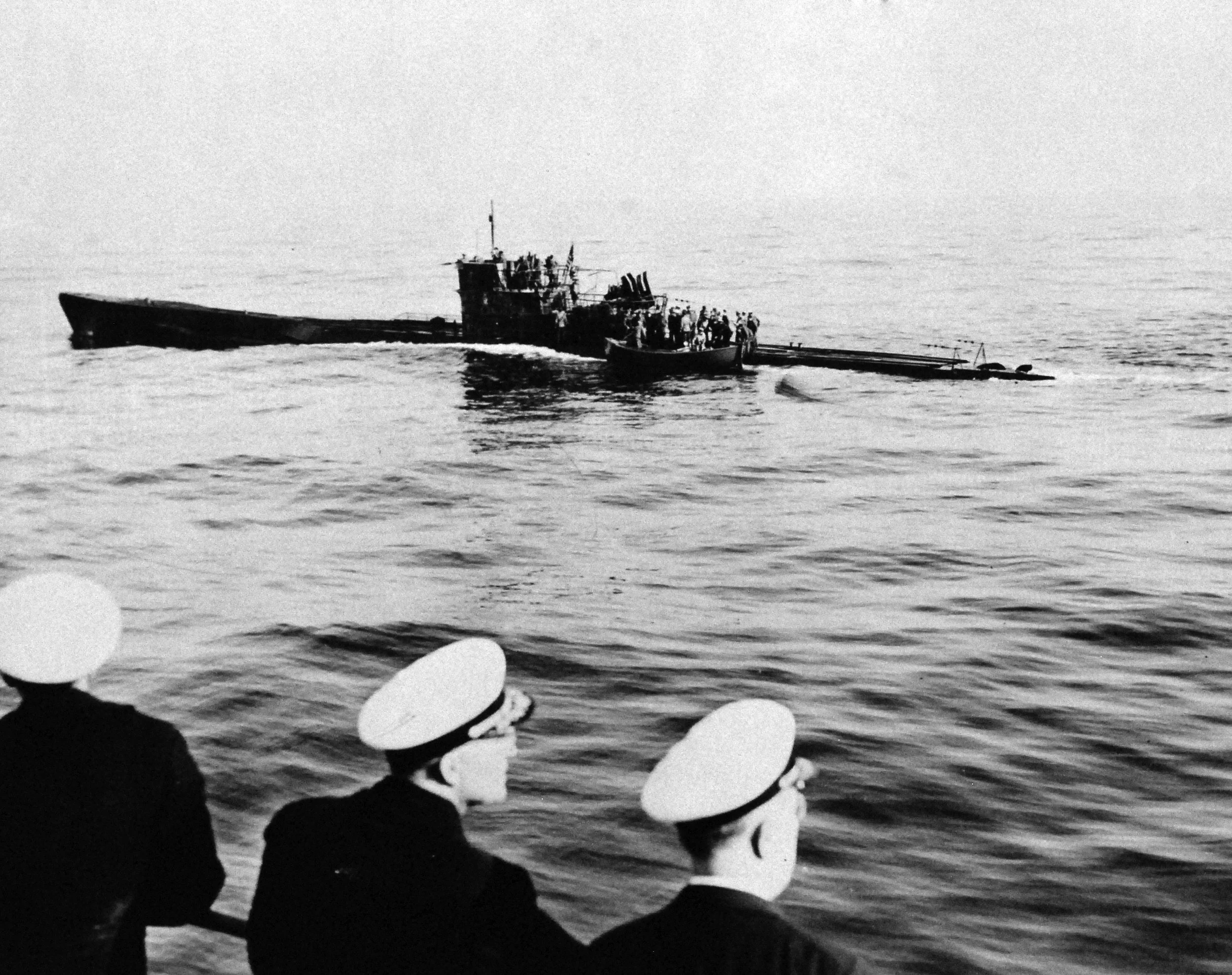
Naval officers supervise the transfer of German U-Boat U-858 to American naval authorities after it surrendered off the coast of Cape May in May of 1945.
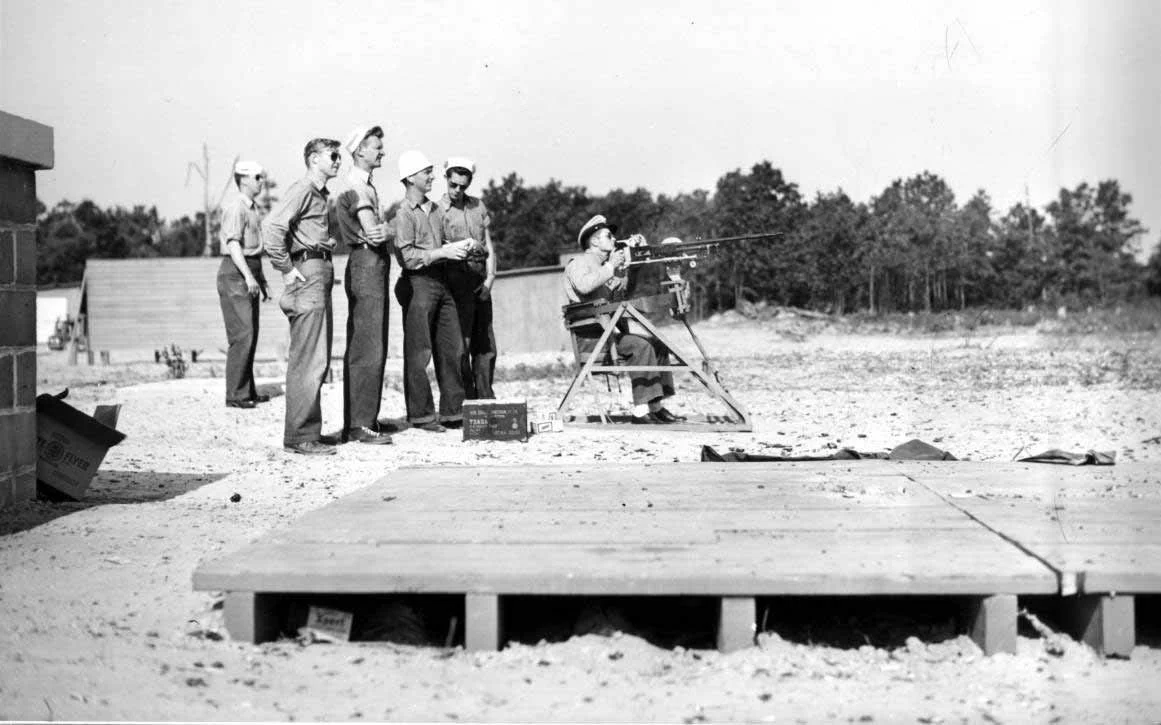
Sailors at the Naval Air Station Wildwood gunnery range in May of 1944, now the site of the airport.