
Cape May’s Secret Weapon Against German Submarines
If you’re not from around here and you’re driving down Sunset Boulevard toward the bay and suddenly spot what looks like a giant concrete chess piece rising out of the dunes, you haven’t been chewing too many edibles (not that you should ever be doing that while driving!). You’re looking at a World War II lookout tower, a relic from a time when Cape May wasn’t just a vacation town, but a military outpost on active coastal defense.
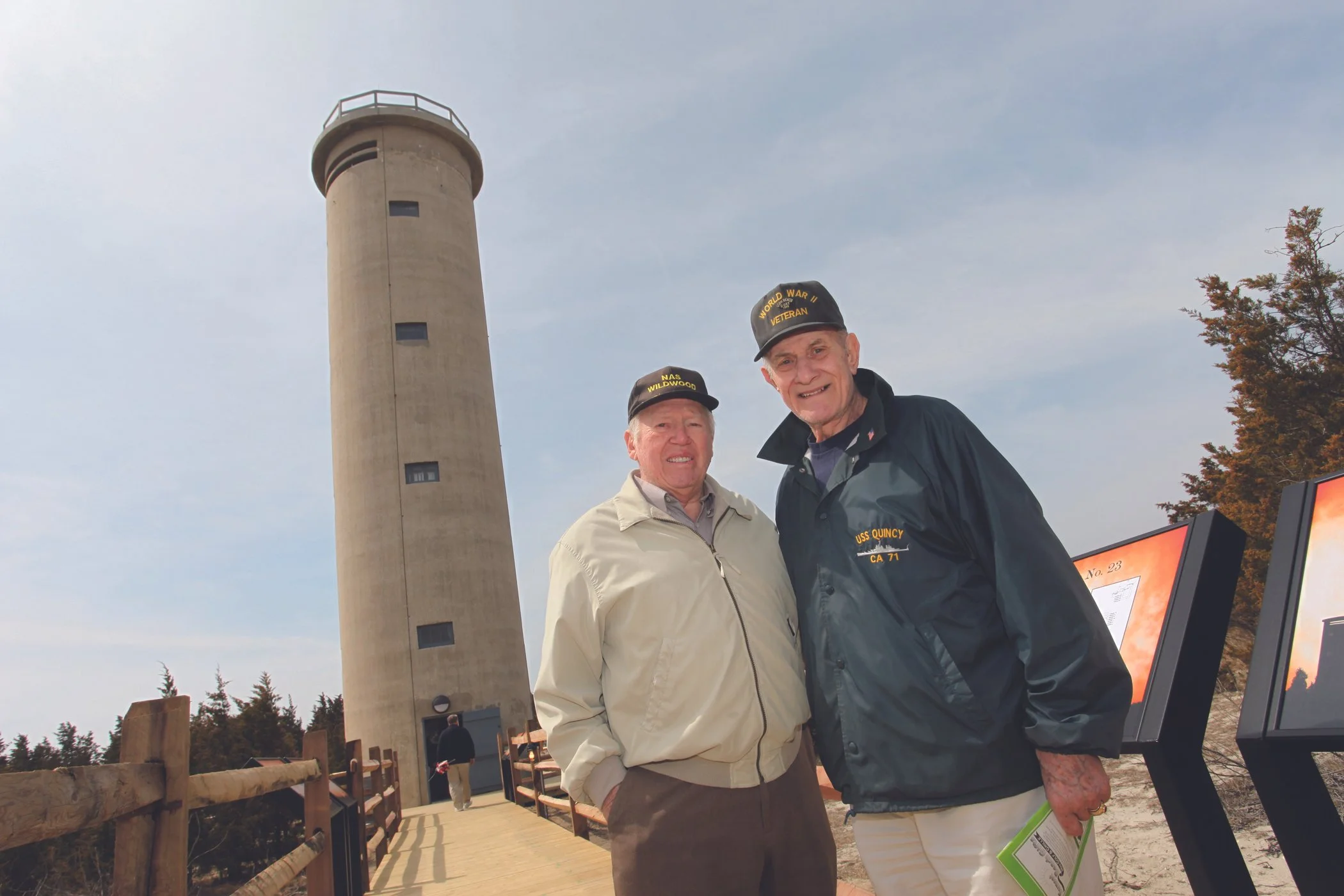
On March 27, 2009, veterans Marvin Hume and Vince Panzano were on hand for the opening of Fire Control Tower 23, which was restored by Cape May MAC and is now a popular, multi-level museum.
Officially known as Fire Control Tower No. 23, it has been standing guard near Sunset Beach since 1942. These days, it watches over beachgoers and sunsets. Eighty years ago, it watched for something a bit more ominous: enemy ships and submarines prowling just offshore.
During World War II, the East Coast of the United States wasn’t the safe area many people imagine — German U-boats operated aggressively along the coastline. When the US entered the war in December 1941, Germany’s Admiral Karl Dönitz immediately launched Operation Drumbeat, with his U-boats discovering a surprisingly undefended American seaboard, where coastal cities remained brilliantly lit and ships sailed with navigation lights. This illuminated merchant silhouettes perfectly for German commanders, leading them to dub the campaign the “American Shooting Season,” sinking many hundreds of merchant vessels.
The waters off New Jersey, Delaware, and the Carolinas were so dangerous they earned the nickname Torpedo Alley. Ships were sunk close enough to shore that explosions could be seen from land — and sometimes debris washed up on the beach.
Cape May’s position at the mouth of the Delaware Bay made it especially important. The bay was the gateway to major industrial ports in Philadelphia, Wilmington, and Baltimore, all vital to the Allied war effort. If enemy submarines could disrupt shipping here, the impact would ripple far inland.
So the US Army fortified the coast. Between 1942 and 1943, the Army built a chain of fire control towers from New Jersey down through North Carolina. They also dredged Cape May Creek, creating a canal to provide a protected route for US ships, a move that properly turned this little resort into an island. These towers weren’t armed. Instead, they were observation posts — essentially the eyes of the coastal defense system.
Cape May County had four towers. The others were located in North Wildwood and Wildwood Crest (both of them later demolished) and, most intriguingly, at what is now the site of the Grand Hotel. (We’ll get back to that one later.) Across the bay, the system connected to the massive gun emplacements at Fort Miles in Lewes, Delaware, part of the Harbor Defenses of the Delaware Bay.
The towers worked in pairs. Spotters using binoculars and optical range finders tracked ships at sea, relaying bearings and distances to the concrete gun battery at Cape May Point, which at that time was about 900 feet inland, believe it or not. Because the artillery crews inside the concrete bunker could not see past the immediate horizon, they relied entirely on the towers’ data. The lookouts would transmit these target coordinates directly to the bunker. By comparing readings from two towers, artillery crews could triangulate a target’s exact location.
It was meticulous, demanding work. No radar screens. No computers. Just manpower, instruments, and hours of staring at the horizon.
The military presence transformed daily life in Cape May. Troops trained on local beaches. Barracks and support buildings appeared throughout the area. Coastal blackouts were enforced so lights wouldn’t silhouette ships at sea.
One mile south of the lookout tower, the US Army rented Saint Mary’s by-the-Sea nuns retreat, which today is Cape May Point Arts and Science Scenter. Six hundred soldiers were accommodated there, and they left a mark. “We had to clean up after those soldiers. They left it in shambles,” Sister Gerry Kenty told Exit Zero in 2013. “The mines were still in the water, so we weren’t supposed to go swimming, but we used to hide behind the jetty, pin up our habits in the back and the front, and go wading.”
The war was very real to Cape May. Ships were sunk within sight of land. Oil slicks and wreckage sometimes drifted ashore. And, as you may know already, the first U-Boat to surrender after the fall of Nazi Germany did so just off our coast. The war was close enough to smell.
Through it all, Fire Control Tower No. 23 stood watch. When the war ended in 1945, the towers lost their purpose almost overnight. Some were demolished. Others were abandoned. The Sunset Boulevard tower survived largely because reinforced concrete is stubborn — and because Cape May has a long tradition of repurposing rather than erasing its past.
For decades, the tower sat quietly along the road, a familiar but unexplained landmark. Visitors guessed it was a lighthouse, a water tower or a leftover from Prohibition (Cape May gets that a lot). Locals knew it had “something to do with the war,” which was close enough for most conversations.
The tower’s next chapter began in the early 2000s. In 2003, Fire Control Tower No. 23 was listed on both the New Jersey Register of Historic Places and the National Register of Historic Places, formally recognizing its historical significance.
Soon after, Cape May MAC took on the challenge of restoring the structure and interpreting its story. Restoration work took place in 2008–2009, supported in part by state historic preservation funding.
In March 2009, the tower reopened as a museum and memorial, complete with exhibits explaining Cape May’s wartime role and a staircase leading to the top — where visitors can now enjoy sweeping views of the Delaware Bay for reasons that are thankfully far more relaxed.
Here’s the part that surprises even many locals: Cape May has a second World War II fire control tower, and it’s not on the beach. It’s inside the Grand Hotel.
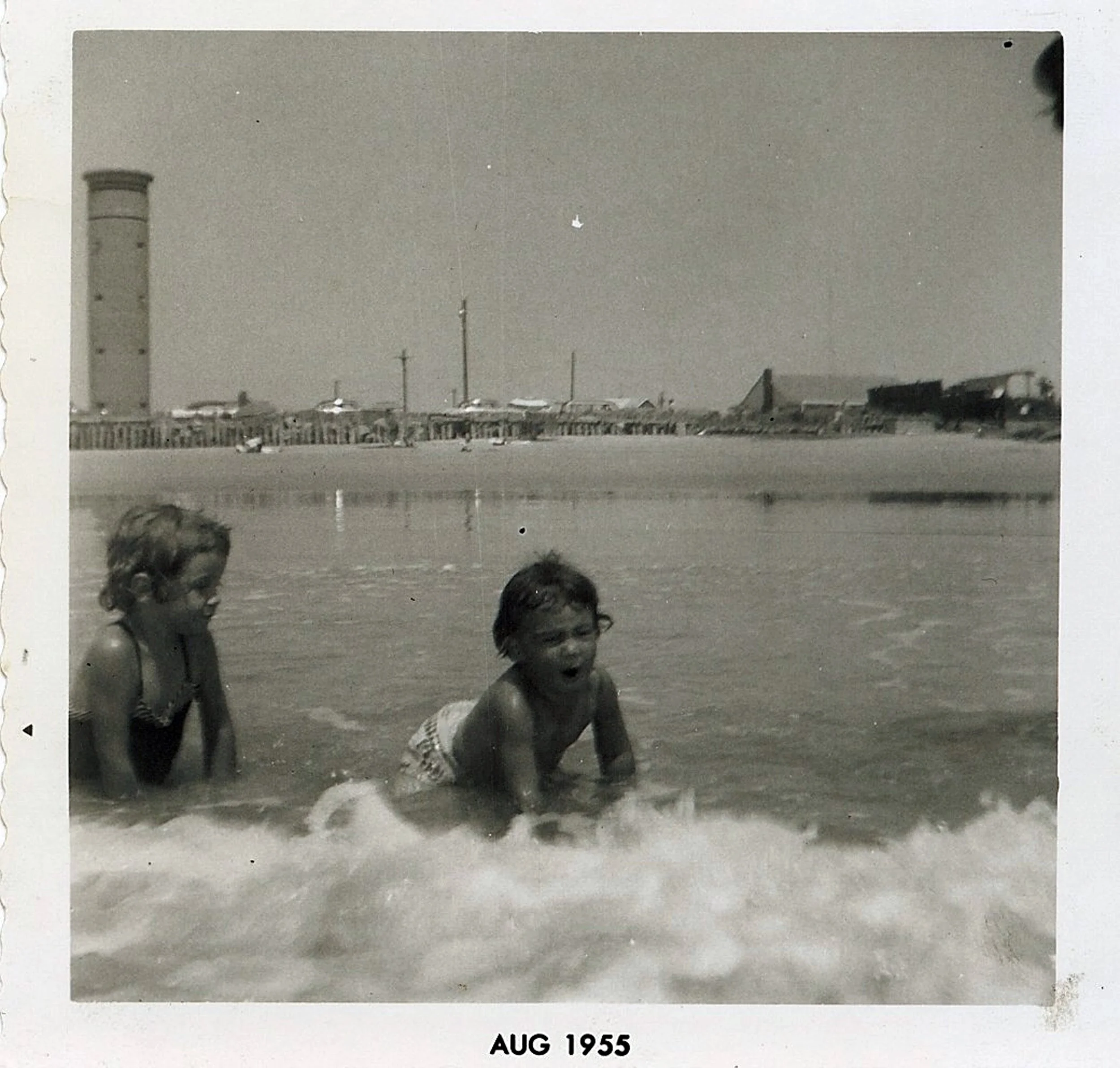
The tower, known as Fire Control Tower No. 24, once stood openly near Beach Avenue. When the property was developed as the Golden Eagle motel in 1964, the builders chose not to demolish the tower. Instead, they built around it, embedding the wartime structure within the hotel footprint.
That motel evolved into today’s Grand Hotel, but the tower remains — still there, still vertical, still unmistakably military concrete amid vacation architecture. It’s not open to the public, but portions of it are visible, a quiet reminder that history doesn’t always get cleared away for progress.
“Most people have no idea the tower is here until they either notice it from the beach or I mention it during a wedding tour,” says Katlyn Mogavero, director of sales and marketing for the Grand Hotel. “It’s right behind one of the ballroom walls, and two of our guest rooms even have rounded walls because they’re built around it. The history buffs especially love hearing that.
“It’s not something we advertise much, because we don’t want people thinking it’s a tour attraction,” Katlyn says. “Today, it’s used for mechanical systems — HVAC equipment for the most part.”
In other words, if you’re a history buff or just Cape May curious, DON’T be bugging the Grand Hotel staff for a look inside the tower. Instead, get thee down to Sunset Beach to fully appreciate the importance of a slab of concrete that, without ever having fired shots, still played a huge role in America’s wartime effort.
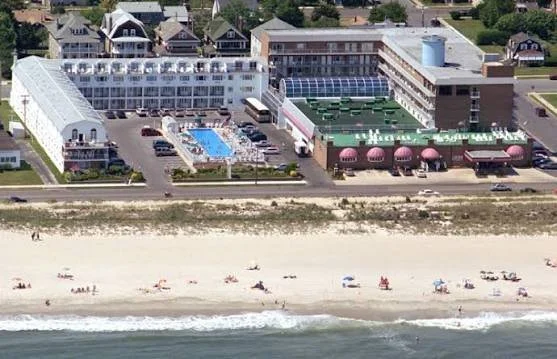
Fire Control Tower No. 24 was located on Beach Avenue. It’s still there today, but is wrapped inside the Grand Hotel (see circled area above). Did you know it was there?
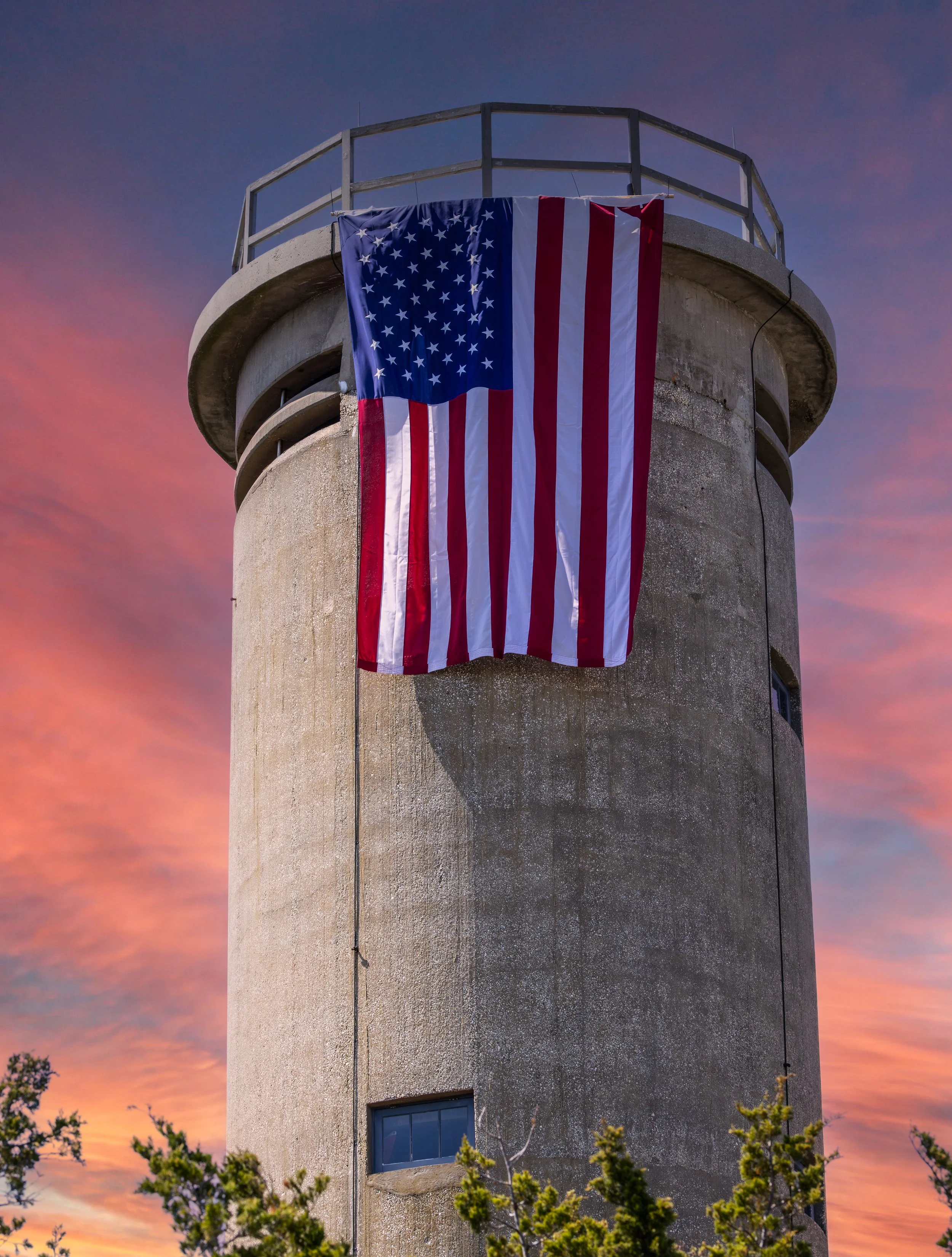
Photo Credit: Werner Tedesco