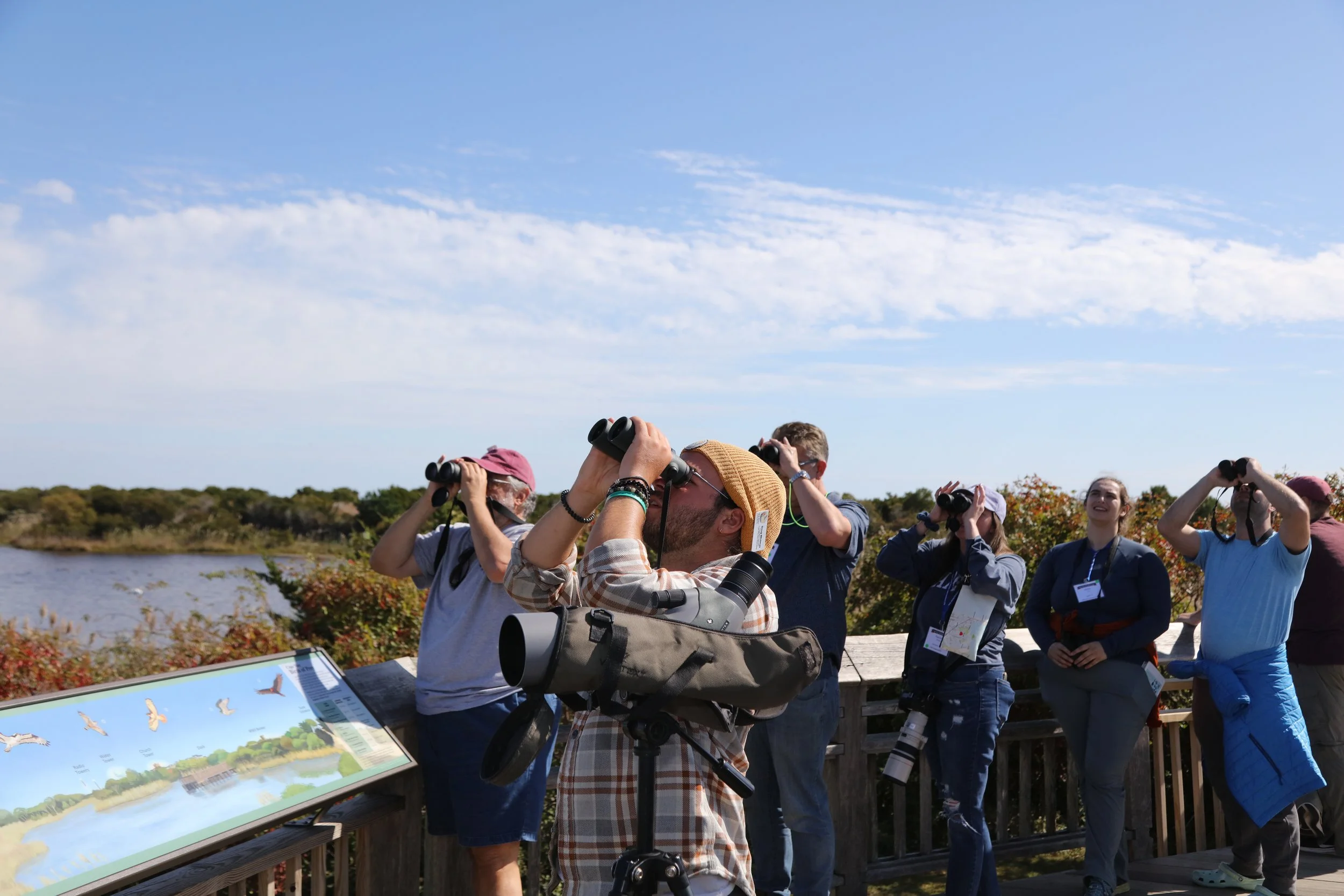
Why This Is The Place To See An Air Show Like No Other
Some birds just fascinate us more than others. Hawks, eagles, falcons and owls are among these hot-button birds, and it’s easy to understand why. These are the aerial aces of the bird world: fast, powerful, exquisitely adapted predators capable of turning an ordinary day of birdwatching into an air show.
The challenge with finding these aerial predators is their relative scarcity — they need lots of room, so for most of the year they spread themselves out across expansive territories that are often remote and difficult to access. It is only during migration that we get to see them in numbers.
Cape May is one such celebrated junction. On good flight days, hundreds of migrating hawks may be seen over a few hours... welcome to the Hawk Watch platform at Cape May Point State Park!
Hawk watching isn’t always for the faint of heart. Some falcons kill by striking their prey in flight, and the violence can be astonishingly precise. Over the course of a season on the platform, observers might witness a dozen or more such encounters. It’s a reminder that what we call an air show is, for the birds involved, a matter of survival.
Some birds have a bill specially designed to snip a cervical membrane. There was one day we had a cuckoo fly right in front of us, and right on its tail was a merlin. The cuckoo opened its mouth and screamed, and the merlin sucker-punched it. We all felt so guilty because we were, of course, cheering for the merlin. We’re all hawk people. They’re fast, they’re powerful, and they push our buttons.
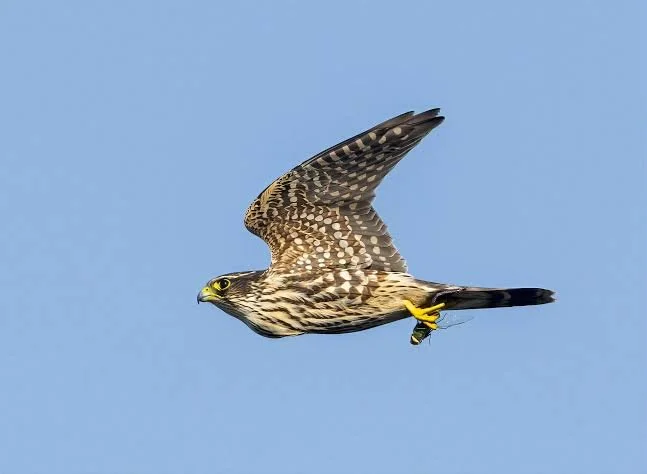
Merlin
Take the peregrine falcon, which, when divebombing for dinner, can outpace a cheetah without breaking a sweat. She can carry a 13-inch northern flicker — a particularly beefy woodpecker — away in her talons. Or consider the bald eagle, one of America’s largest birds of prey and, according to some, a feathered pirate. It has been known to steal live fish from an osprey’s talons, apparently finding robbery easier than fishing.
Such behavior helped fuel Benjamin Franklin’s objections to the bald eagle as America’s national symbol. Franklin preferred the wild turkey, considering the eagle less than admirable in character. The eagle won the honor anyway, and its reputation for opportunism remains intact.
An average of 50,000 migrating hawks are tallied annually at the hawk watch platform, their numbers recorded by counters hired by Cape May Bird Observatory.
Twelve raptor species are tallied annually, including large numbers of peregrine falcons and as many as a dozen golden eagles. Bald eagles are seen daily. Other migrating birds include herons, egrets and waterfowl.
A count tally board, updated daily, stands at the base of the platform. And yes, that one-day record — 21,800 migrating hawks in October 1977 — is accurate. It was the flight that helped earn Cape May its nickname: the Raptor Capital of North America.
The number and mix of birds you’ll see depend on the weather and the timing of your visit. Fifty to 100 birds representing 17 raptor species is a reasonable average for a visit, although a good flight can make those numbers seem modest.
American kestrels, our smallest falcon, and ospreys typically kick off the season in August and September. Numbers of broad-winged hawks follow in September. Sharp-shinned and Cooper’s hawks dominate the skies through October, while November belongs to the turkey vultures, red-tailed and red-shouldered hawks, and even — gasp, sigh — the regal golden eagle.
Given strong northwesterly winds, many birds linger, reluctant to cross Delaware Bay. Mixed “kettles” of soaring hawks are typical in November. These concentrations offer easy study and often bring the birds into surprisingly close view.
For those who like the flash and dash of falcons, a visit timed for mid-September to mid-October will be most productive. November features the greatest variety of raptors and often the spectacle of thousands of tree swallows buzzing low over Bunker Pond. When all the ducks lift off, look up. There’s an eagle up there. Count on it.
While the official counter and seasonal interpreters are gone by November 30, hawks continue to migrate into December. Just because the peak of migration has passed doesn’t mean the show is over.
Observers are advised to dress warmly. The platform is exposed on all sides, and the wind can make a mild day feel downright raw. Binoculars are highly recommended. Tripod-mounted spotting scopes are not particularly useful and are likely to tip over in the wind.
Several field guides can help with raptor identification. Jerry Liguori’s Hawks at a Distance is the gold standard. The two-page raptor plate in David Sibley’s The Sibley Guide to Birds is both comprehensive and comparatively arranged. For those wanting a deeper dive into raptors, try Birds of Prey by Dunne and Karlson. All these books are available at the CMBO Center, 701 East Lake Drive.
Don’t be surprised if your binoculars aren’t up to the challenge. Zeiss loaner binoculars are available on hand. Take the opportunity to see how premium optics perform in your hands.
If you’re unfamiliar with using binoculars, here’s the trick: keep your eye on the bird, then raise the binoculars so they fall between your eyes and your target. Don’t slam the optics to your eyes and pan them wildly around. You’ll find nothing. And when a falcon streaks across the sky, you’ll want to be ready.
Hawk watchers need not get up with the birds. Many raptors don’t begin migrating until midmorning, when thermal activity increases. Rainy days diminish the flight, but osprey, northern harrier and the falcons are undaunted by rain. Whatever the conditions, there will almost always be hawks flying.
The history of birds and raptors in Cape May has not always been amicable. During the 1920s and 1930s, hawks were methodically shot by gunners lined up along Sunset Boulevard. While most hawk species were protected, bird-eating hawks such as sharp-shinned hawks, Cooper’s hawks and even peregrines were not. Wardens hired by the National Association of Audubon Societies monitored the slaughter.
The hawks didn’t go to waste, either. Many were served up for dinner. One old hawk shooter I interviewed allowed that four or five sharp-shinned hawks could feed the entire family during the Great Depression. Roger Tory Peterson, one of the hired wardens, admitted to sitting down to a meal of sharp-shinned hawk served locally. When I asked whether any Cooper’s hawks might have been served up, the celebrated ornithologist wryly observed, “I didn’t identify any by taste.”
Those unable to visit the Hawk Watch in person can keep up online. Up-to-the-minute sightings are posted on the Cape May Bird Observatory website. Type “Bird Cape May” into your search engine, click on “Cape May Bird Observatory,” then “Watches.” Scroll down to the Cape May Hawk Watch. It’s the next best thing to being there.
But migrating hawks are not the only reason visitors flock to the platform. They come for the company, too. Fellow hawk watchers tend to be welcoming and engaging. Indeed, the platform has a coffee-shop conviviality, with conversations that are as lively and varied as the birds overhead.
On my most recent visit, I found myself seated next to a retired history professor so enamored of the hawk migration that he had moved to Cape May Point. In short order, we discovered that we shared an interest in Winston Churchill.
Every day on the platform is different because every day brings a new mix of observers, first-timers and veterans alike.
So come along and add your own insights to the mulligan stew that is hawk-watch banter. After a single serving, you’ll come back for more. More birds, more surprises and more camaraderie at the Raptor Capital.
The handicap-friendly platform and pristine bathroom facilities are maintained by New Jersey Forest and Parks. Access is free, and the platform is rarely crowded. Visitors come from across the continent and abroad to enjoy the spectacle. Photographic opportunities abound, and your chances of capturing a thumbs-up Facebook post are nearly guaranteed.
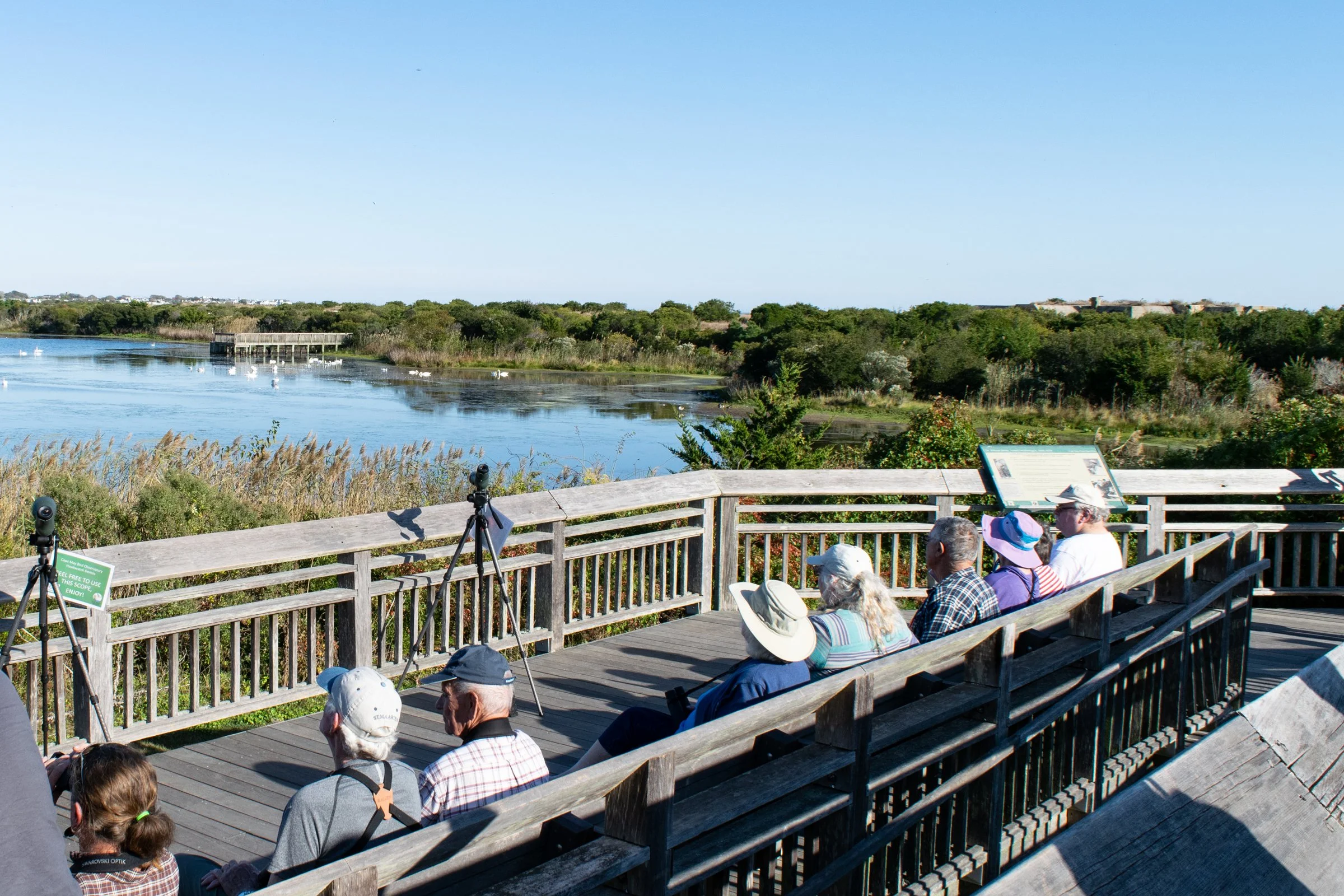
The Hawk Watch Platform at Cape May Point State Park
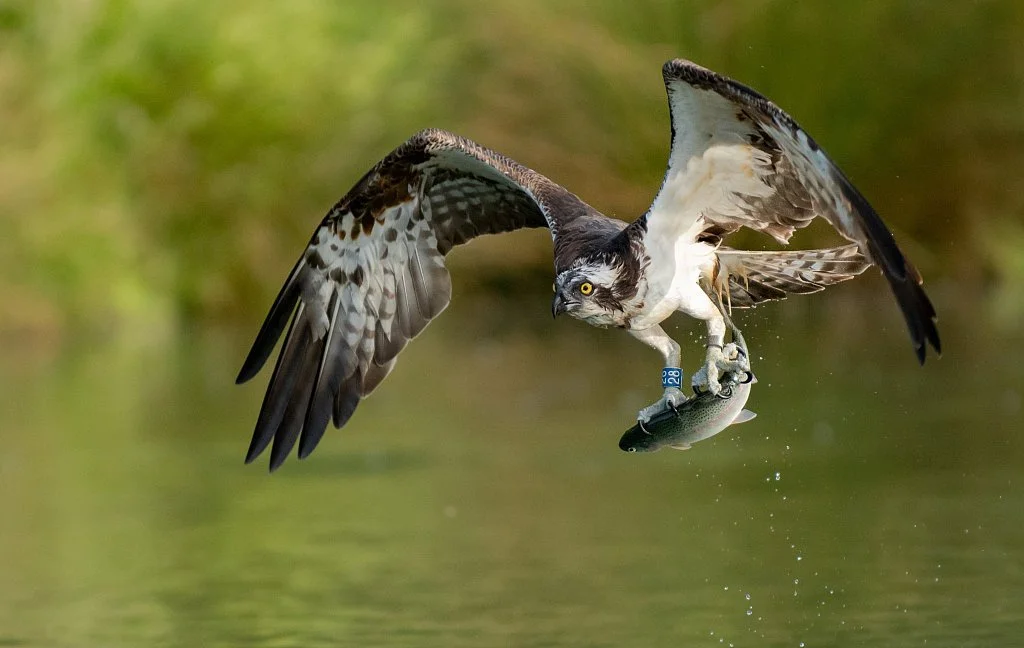
Osprey