
The first Cape May Lighthouse was built on land that is now underwater. The second was so poorly constructed that it needed replacing after 12 years. Not a terrific record for buildings whose purpose was to help avoid disaster.
Then came the tower of 1859. This one the builders got right — it’s still there.
Getting the public through the door would prove another matter. More than a century later, a local innkeeper, Tom Carroll, had an idea for the locked-up lighthouse.
But first, a small geographical correction to satisfy those folks who like to make comments on social media: The lighthouse isn’t in Cape May. It isn’t in the Borough of Cape May Point, either. It stands in Cape May Point State Park, which, despite the name, is in Lower Township. Glad to get that out of the way.
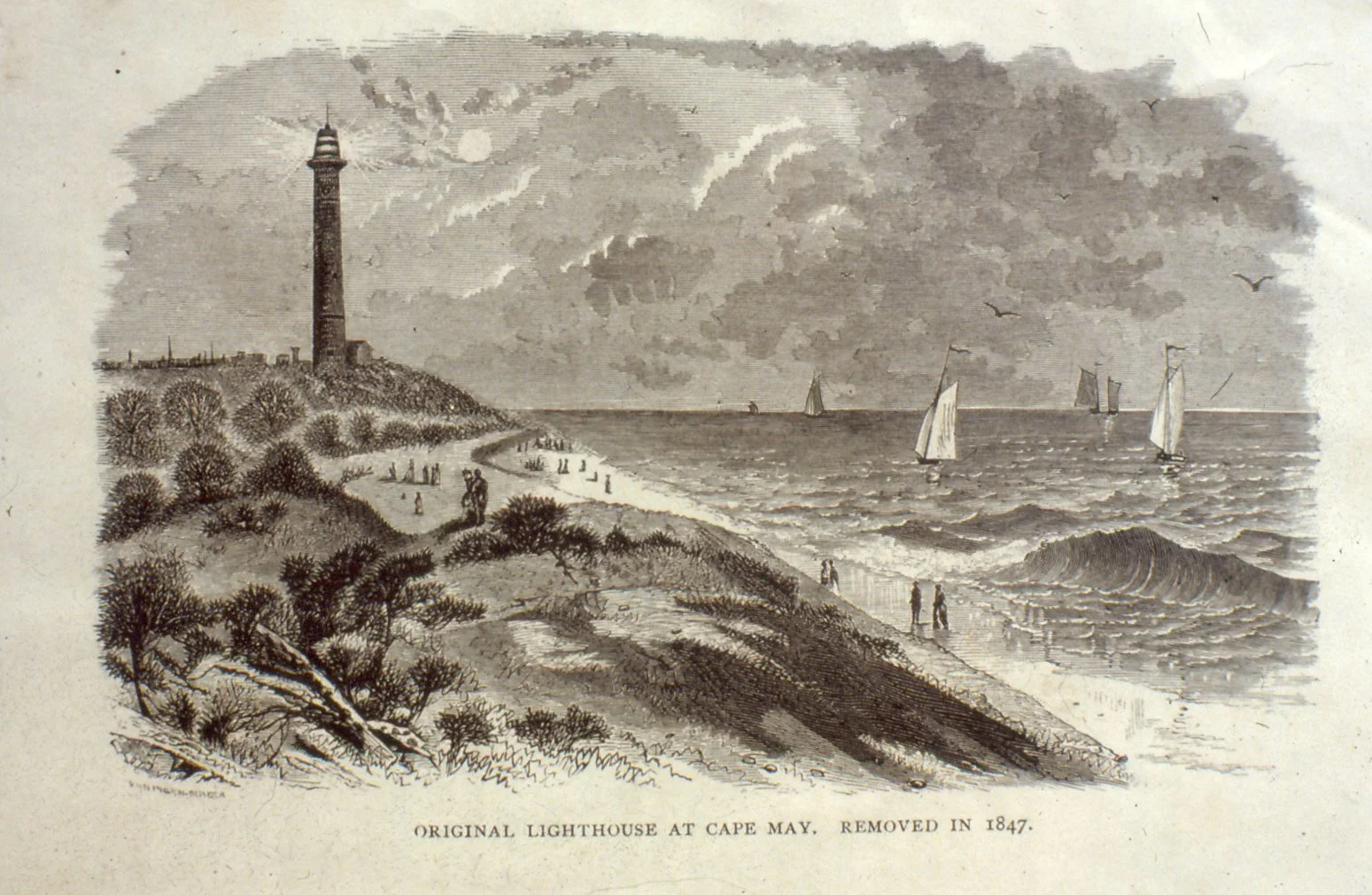
The original Cape May lighthouse was built in 1823 but didn’t last long, and was replaced in 1847 by a structure so poorly built it was replaced in 1859.
The first tower began operating in 1823, marking the northern side of the entrance to Delaware Bay. Its revolving apparatus used 15 lamps and reflectors to produce a flashing light, distinguishing it from the fixed beacon across the water at Cape Henlopen.
Getting those two muddled was not something you wanted to do in the dark.
The tower stood about 70 feet tall. Unfortunately, the ground beneath it was considerably less dependable than the brickwork. By 1847, the sea was surrounding the lighthouse at high tide. The light was discontinued, and the site later disappeared underwater.
The replacement, built that year, was taller and stood on a high bluff. Surely things would work out better this time?
An inspection in 1851, just four years after construction, found a damp tower, rusty fittings and appallingly unfinished woodwork. The inspector’s verdict included the damning phrase “the whole thing rude in the extreme.”
The third lighthouse was a much more serious proposition. At 157 feet, six inches, it dwarfed both earlier towers. Its construction incorporated two separate brick walls: a tapering outer shell, nearly four feet thick at the bottom, and an inner cylinder supporting the cast-iron spiral staircase.
At the top was a Fresnel lens, an elaborate arrangement of glass prisms that concentrate the lamp’s light into a powerful beam.
The new beacon shone for the first time on October 31, 1859. A Halloween debut, although the object was to make the coast considerably less frightening.
For the men tending it, the lighthouse was not a scenic backdrop. It was a demanding workplace. A head keeper and two assistants generally staffed the station, carrying oil up the tower and keeping the lens clean and the machinery working.
Their families lived beside the tower in two houses completed around 1860. Two houses for three keepers and their households was not ideal arithmetic. The assistants’ families had to share, and requests for more accommodation continued for years.
Then there were the gardens. Harry Palmer, the last resident head keeper, took enormous pride in his hydrangeas and his crops of pole beans, tomatoes and corn. His grounds won local gardening awards in the early 1930s.
Palmer’s wife, Florence Arabelle, known as Belle, subsequently served as custodian. Her contribution is now commemorated in one of Cape May MAC’s interpretive panels.
Technology gradually changed the work. Electricity replaced the business of fueling a lamp; in 1946, the Fresnel lens was removed and an aerobeacon installed. The tower remained useful, but it no longer required the old complement of resident keepers.
By the time Tom Carroll began pursuing MAC’s involvement in 1983, a visitor could admire the lighthouse from outside. Going upstairs was another matter.
“At the time, it was locked up,” Tom told me in an interview last year. “Nobody went in but the Coast Guard to change batteries on the light and stuff like that.”
Tom saw an opportunity to restore the tower and let people climb it. Importantly, the Coast Guard was not opposed to somebody else assuming responsibility for the building.
“They were interested in somebody taking it over, as long as the Coast Guard could keep their light in it,” said Tom.
Keeping the light working didn’t require keeping the public out. There was also a useful overlap between Tom’s professional life and his preservation interests. He wasn’t simply a former Coastie making a few calls to old friends. He was still a Coast Guard commander.
“I think being a commander in the Coast Guard at that point was helping a lot,” he said, “but I was also representing MAC, which by that time was a very good organization.”
MAC had already taken on the Emlen Physick Estate. The lighthouse offered another chance to give a historic building a public life.
Not everyone welcomed the prospect.
“We spent three years fighting the residents, and the mayor, of Cape May Point, who absolutely didn’t want it,” Tom recalled.
The opposition even produced a competing proposal. “In fact, Cape May Point Civic Club put in a counter-offer to the Coast Guard, saying they would lease the lighthouse, but not do anything with it,” he said.
That is quite an alternative vision for a landmark: acquire the lease to make sure nothing changes.

The current lighthouse stands between broken remnants of the hastily constructed 1847 building it replaced.
Tom and his colleagues at MAC persisted. In December 1986, the arrangement finally came together. The Coast Guard leased the tower to the State of New Jersey’s Division of Parks and Forestry, which subleased it to MAC for $1 per year.
The Coast Guard could keep its navigational light. MAC could restore the building, interpret its history and open the door.
MAC opened the ground floor on July 18, 1987. On May 28, 1988, visitors could finally climb the tower.
The work, however, was nowhere near finished. Restoring a lighthouse is not simply a matter of finding somebody with a very long ladder and a tin of paint. There was masonry to conserve, lantern and watch levels to restore, and a staircase that would have to withstand generations of visitors.
The little oil house became a visitor center and museum shop. Further projects have tackled the stairs, railings, roof and lantern windows. Preservation, particularly beside the sea, is not something you finish and forget.
As of this date, MAC has invested three million dollars in capital improvements at the lighthouse, alongside its annual maintenance spending. Coincidentally, at least three million climbs have been made since the tower opened. Not bad for an idea that took three years to get past the objections.
Today, New Jersey owns the lighthouse, MAC looks after the historic attraction and the Coast Guard maintains the beacon. It remains an active aid to navigation, flashing every 15 seconds. Not simply an ornament, however often it appears in somebody’s holiday photographs.
And the climb gives you something a photograph cannot. From the watch gallery, the relationship between the ocean, the bay and this narrow end of New Jersey becomes wonderfully clear. The lighthouse’s purpose makes sense in a way it never quite does from a car window. It also tends to give me a bit of a queasy stomach when I look all the way down.
Those 199 spiral steps provide an opportunity to consider the people who went up them carrying oil rather than a smartphone. There was no triumphant holiday photograph at the end of their climb. There was a job to do, followed by another climb tomorrow.
I’ve climbed those 199 steps quite a few times and it isn’t getting any easier. Yes, I do have to stop for a breather on at least one landing. Turns out, it’s a part of an exercise regimen for some folks.
“People get memberships to incorporate it into their workouts because it really does cardio, leg and glute work like no other exercise,” said Jody Alessandrine, Cape May MAC’s Director and CEO. “The lighthouse and tower admissions are free with membership.”
Given that memberships are only $50 ($75 for a joint membership), I would say that compares rather favourably with your average gym — and the views are far superior.
Tom Carroll’s achievement was to let the rest of us experience the building rather than merely look at it. The keepers’ workplace became somewhere their stories could be told.
When I asked whether he was proud of what he had helped accomplish, Tom was characteristically restrained.
“It’s not like I go around bragging about it, but yes, it worked out great in the end.”
He’s entitled to brag. Just a little.
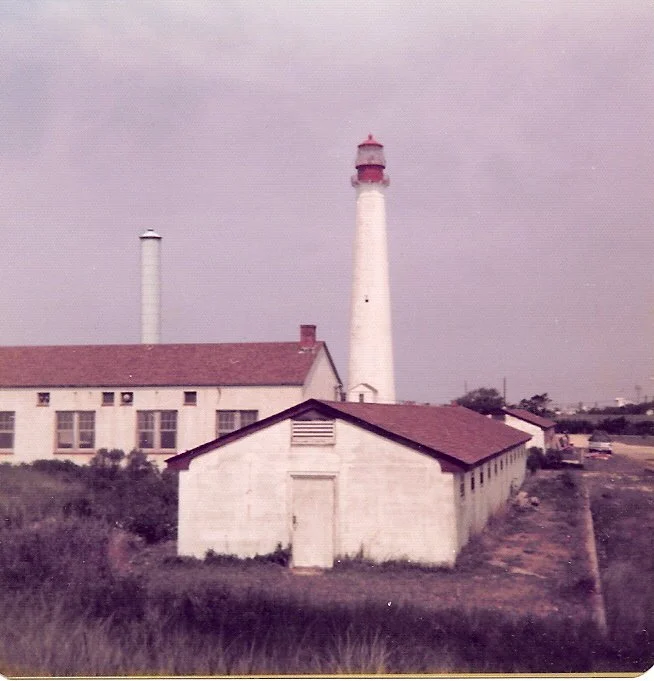
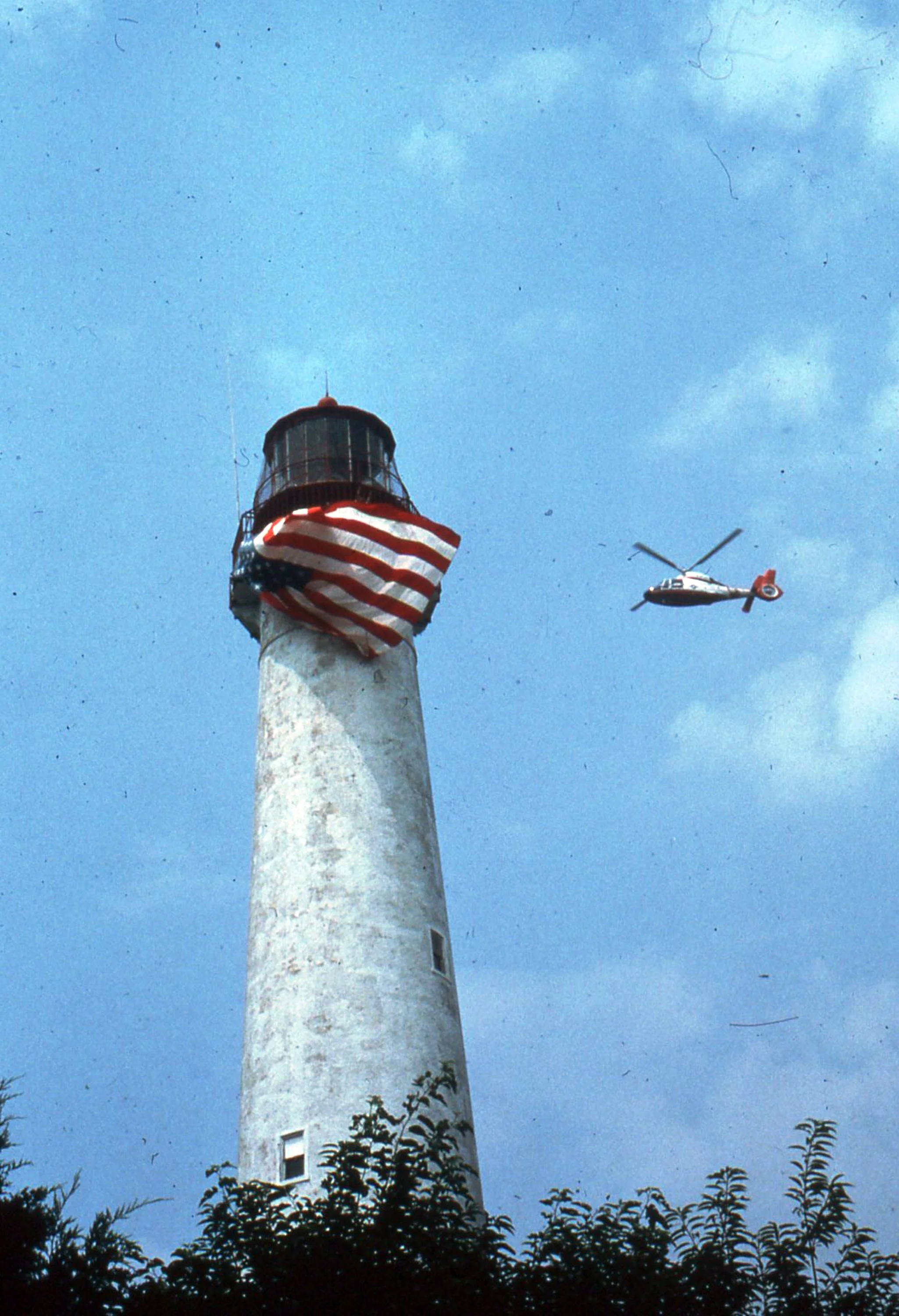
The structure before it was restored by Cape May MAC and opened to the public, in 1988.