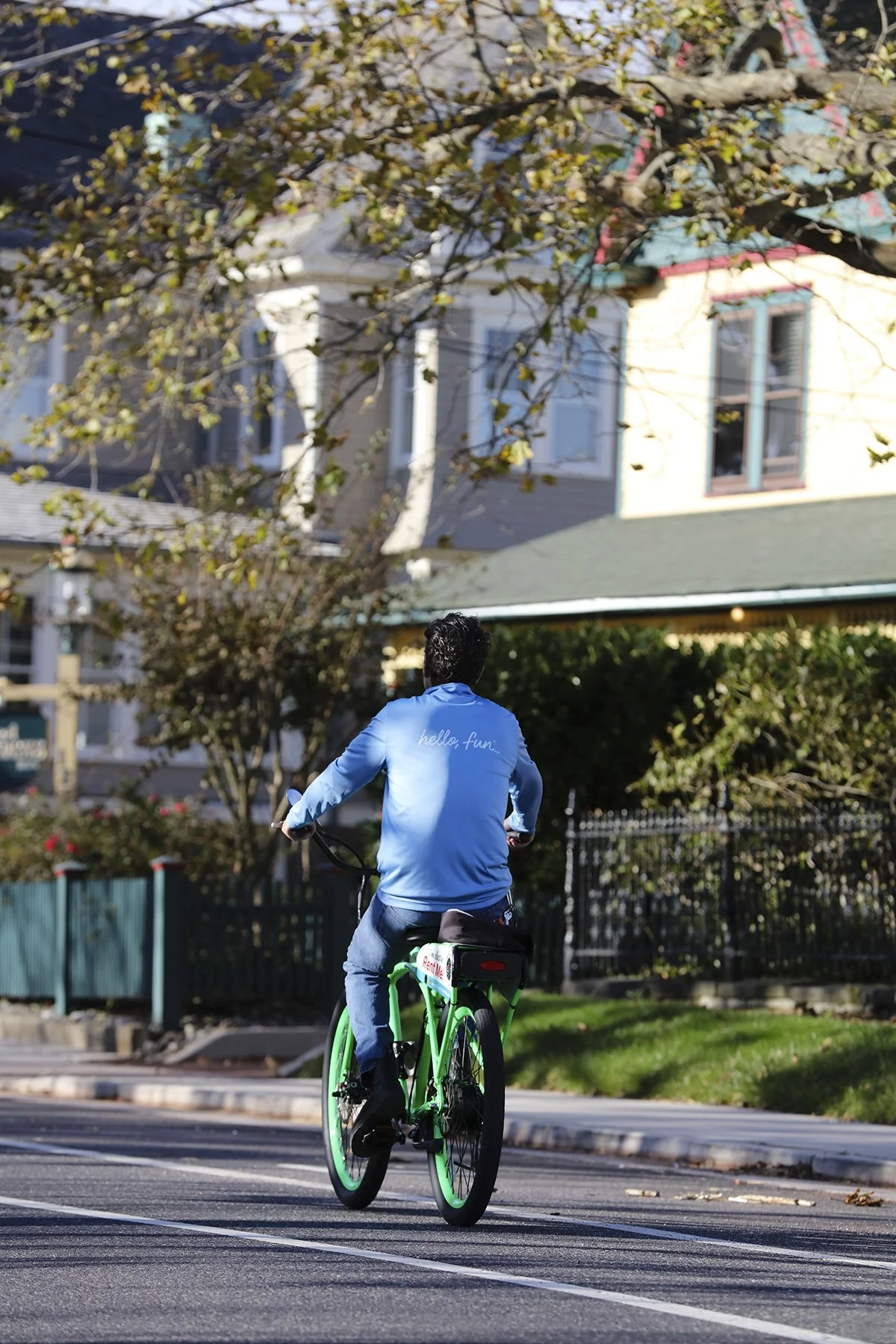
Cape May likes the idea of bicycles. It likes the romance of them — the notion of families pedaling around in the salt-sprayed air, children laughing in baskets, grown men rediscovering their youth in a straw hat and a faded beach patrol T-shirt.
What Cape May does not always like, in practical terms, is what bicycles require. They require room. They require patience. They require people to obey stop signs. They require drivers not to behave like maniacs. They require tourists not to act as though being on vacation is a legal defense. And, perhaps most offensively of all in a town like this, they sometimes require the sacrifice of parking.
And if there is one thing Cape May loves more than the idea of bicycles, it is the idea of parking for the tourism masses.
Which is how I found myself talking to Jim Moffatt, who has been wrestling with all of this for the better part of a decade.
Jim has been on the City of Cape May Bicycle and Pedestrian Safety Committee since it was created in the summer of 2017, during Mayor Chuck Lear’s first term. He is the only original member still standing. He was not the first chairman — he only took that role in January — but he is the old hand, who has watched this from the start.
He joined the committee because he felt Cape May needed work. “I thought that Cape May was not particularly a bicycle-friendly community, compared to other communities that I’ve seen out there.” He pointed to Ocean City as the obvious comparison. A shore town, not a fantasyland. A place dealing with tourists, seasonal congestion and all the usual arguments about who gets what piece of the road.
So after nine years of meetings, maps, reports, recommendations, debates, nudges and municipal patience-testing, has Cape May improved? “To a certain extent, yes,” Jim said. “We do have more bicycle lanes. We have lowered some speed limits.”
That is the good news. There is more attention to lights, helmets and enforcement. More awareness that safety is not just about cars not hitting things, but about the entire summer choreography of wheels, bodies, visitors and nerves.
“Either the police chief or one of his lieutenants attend most of our meetings, and we have dialogue with them about education and enforcement,” Jim said. “Our number one overall mission is safety. Safety for bicycle riders, for pedestrians, for people walking across the street, for drivers, passengers of automobiles.”
The committee has worked on practical things, too. “We spent a lot of time on bicycle maps of the community. It’s a multicolored map, so that, as we show a street, if it’s red, try and avoid that street. If it’s in green, it’s safe for cyclists.”
That may not sound terribly glamorous, but anybody who has ridden a bike here knows how useful it is. Some roads in Cape May are simply bad ideas. “How do you get from the beach to West Cape May?” Jim said. “Do you go down Broadway? Hopefully not. Definitely not West Perry.”
The committee also had a head start. Before it was formed, the city had already commissioned a substantial bike and pedestrian study, and Jim said that report became something like their bible.
“It was a very useful survey,” he said. “I’d say maybe 50 percent of their recommendations have gotten done.”
Only in local government can “50 percent over many years” count as brisk progress, but there you are.
Part of the problem is jurisdiction. “One of the issues is that a number of the significant roads in town are county roads,” Jim said. “For instance, Lafayette Street and Sunset Boulevard.”
Which means Cape May can adjust some things on its own, but not everything. “We can get the city speed limit changed relatively easy,” he said. “The county roads are a whole different story.”
That is one of those maddening civic realities the average person never thinks about until they want something done. Cape May can want a safer street. The county can have different priorities. The road sits there in the meantime, unchanged.
You can talk all day about safety, traffic calming, bike lanes and best practices. But the instant a proposal threatens to remove parking spaces, it runs into a wall of reality.
“You could have all sorts of bike lanes,” Jim said, “but you’d have to remove some parking.” This is why some bike lanes in town feel less like infrastructure than like an apology. They begin hopefully, narrow suddenly, disappear altogether or fill up with parked cars.
“In some areas, there’s enough room for a bike lane, but then all of a sudden it squeezes in, but they have to keep the parking,” Jim said. “And that’s where it almost becomes more dangerous. You’re in a bike lane and having a great time and then suddenly the bike lane disappears.”
And of course, Cape May is not one town. It is two: Summer and offseason.
In summer, everything multiplies at once. “The number of bikes exploded, both e-bikes and regular bikes,” Jim said. “And cars and golf carts.”
The roads, meanwhile, remain roughly the same width they were when most traffic had hooves. “The narrow streets have not gotten wider,” Jim said. “You’re not gonna take one of the old narrow streets and take away the sidewalks and make the street wider and take away the trees.”
Now, on top of all that, there is the e-bike question. When the committee started in 2017, Jim said, e-bikes were barely part of the discussion. Now they are the top priority.
Jim is measured about the new New Jersey e-bike law, pushed through at the very end of Phil Murphy’s governorship. He sees some value in basic regulation, especially around age, helmets and lights. But he is plainly uneasy about the rest of it.
“There’s some people that feel strongly this isn’t the way it should be. Others feel it’s an abomination. And I guess I’m a little bit in the middle.”
What does he like about the law?
“That there is some regulation there, for instance from an age standpoint,” Jim said. “I don’t think 11- and 12-year-olds, who are riding e-bikes today, right in our own community, should be doing that.”
What does he not like?
“To have people go through all the red tape of getting registered, getting liability insurance, there’s a lot of red tape built into it,” he said. “That is expensive, time-consuming governmental red tape that does nothing to help make it more safe.”
That is the point where Tom Roth enters the story.
Tom owns Cape Island Bikes and has been supplying e-bikes for a long time — since 1999, he said. He is not some newcomer looking to make a quick buck from the latest fad. He has been dealing with these machines for decades, and his view of the state law is not diplomatic.
“It’s the most stupid legislation I’ve ever heard in my entire life,” Tom told me. “It was an overreaction in the name of safety that was completely unwarranted.”
His main argument is that lawmakers aimed at the wrong target. In his view, the real problem is not the ordinary low-speed e-bikes being used by older riders, couples and vacationers taking it easy around town. It is the rise of so-called e-motos — electric motorcycles masquerading as bicycles.
“These are not low-speed electric bicycles,” he said. “These are motorcycles … the companies are flat-out lying when they say this is a 50 mile-an-hour e-bike that’s street legal because it has pedals.”
Tom is especially irritated because, he says, responsible rental businesses were already stricter than the state. At Cape Island Bikes, you have to be 21 and have a driver’s license to rent an e-bike. Riders get helmets. They get training. Safety has never been an afterthought.
That is what makes the law so maddening to him. He believes the invisible majority of e-bike riders — especially the sort who rent in Cape May — are already doing things the right way.
“At our shop, the average consumer renting an e-bike, first of all, they’re couples, and they’re more than 50 years old,” Tom said. “They’re doing it for health reasons, leisure reasons, and they’re doing it the right way.”
Jim, for his part, suspects enforcement in Cape May will be practical rather than theatrical. He does not imagine police officers stopping every mildly competent visitor and demanding proof of insurance.
“People are not gonna be stopped if they’re just riding 20 miles-an-hour, obeying laws,” he said. “You’re not gonna be stopped to be asked, I want to see your insurance card.”
So who will get stopped?
“I think the people who will be stopped are people going 35 miles-an-hour,” he said. “Or they’re going at night... there’s no lights on. An 11-year-old going down Beach Drive without a helmet.”
That sounds sensible enough. But sensible enough is not always the same as workable, especially in a tourism town. Tom worries that the law sends exactly the wrong signal. “It is a black eye for Cape May, and actually, it’s not just Cape May, any beach town, any resort town, the state of New Jersey,” he said. “There’s nothing good about this new legislation.”
The larger point, from both men, is that our bike problem is not really about bicycles alone. It is about success. Too many people want to be here, too many want to drive, too many want to bike, too many want to park, too many want to behave as though vacation exempts them from common sense.
I asked Jim whether people sometimes come here in golf carts and on bikes and leave their brains behind.
“Oh, yeah,” he said. “I’m on vacation. I’m entitled. I can be cavalier. For sure.”
Not just tourists, either.
“There’s also, I believe, a band of local people that have somewhat of a disregard for stop signs, speed limits, having to wear a helmet and having to have a light on.”
So here we are. Cape May wants to be bike-friendly. In some ways, it already is. Riding here can still be one of the nicest ways to experience the town. But it also means narrow streets, vanishing lanes, parked cars, county roads, golf carts, rental riders, summer crowds and now a state e-bike law that may be more confusing than helpful.
Jim is still optimistic, but only in the realistic, slightly battle-worn way a person becomes optimistic after years of committee work. “It’s not an overnight thing,” he said. “It’s not, all of a sudden we have a whole new remedy here that’s gonna be easy to implement. If it was easy to implement, it would already have been implemented.”
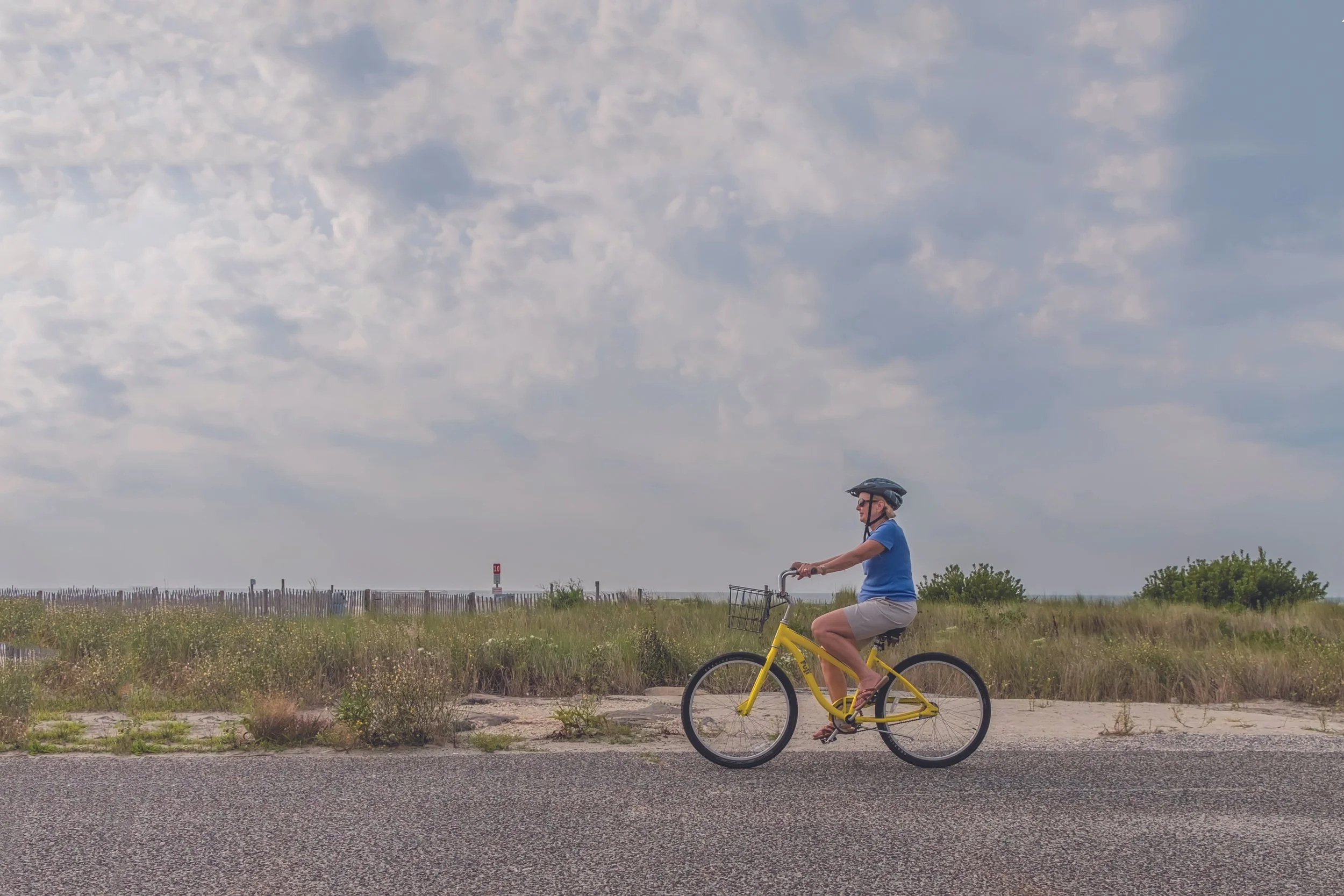
Biking on Cape May’s promenade is a wonderful way to start the day, but try to pay attention to the fact that it’s only permitted between 4am-10am from mid-May through mid-October. Photo by Charles Riter
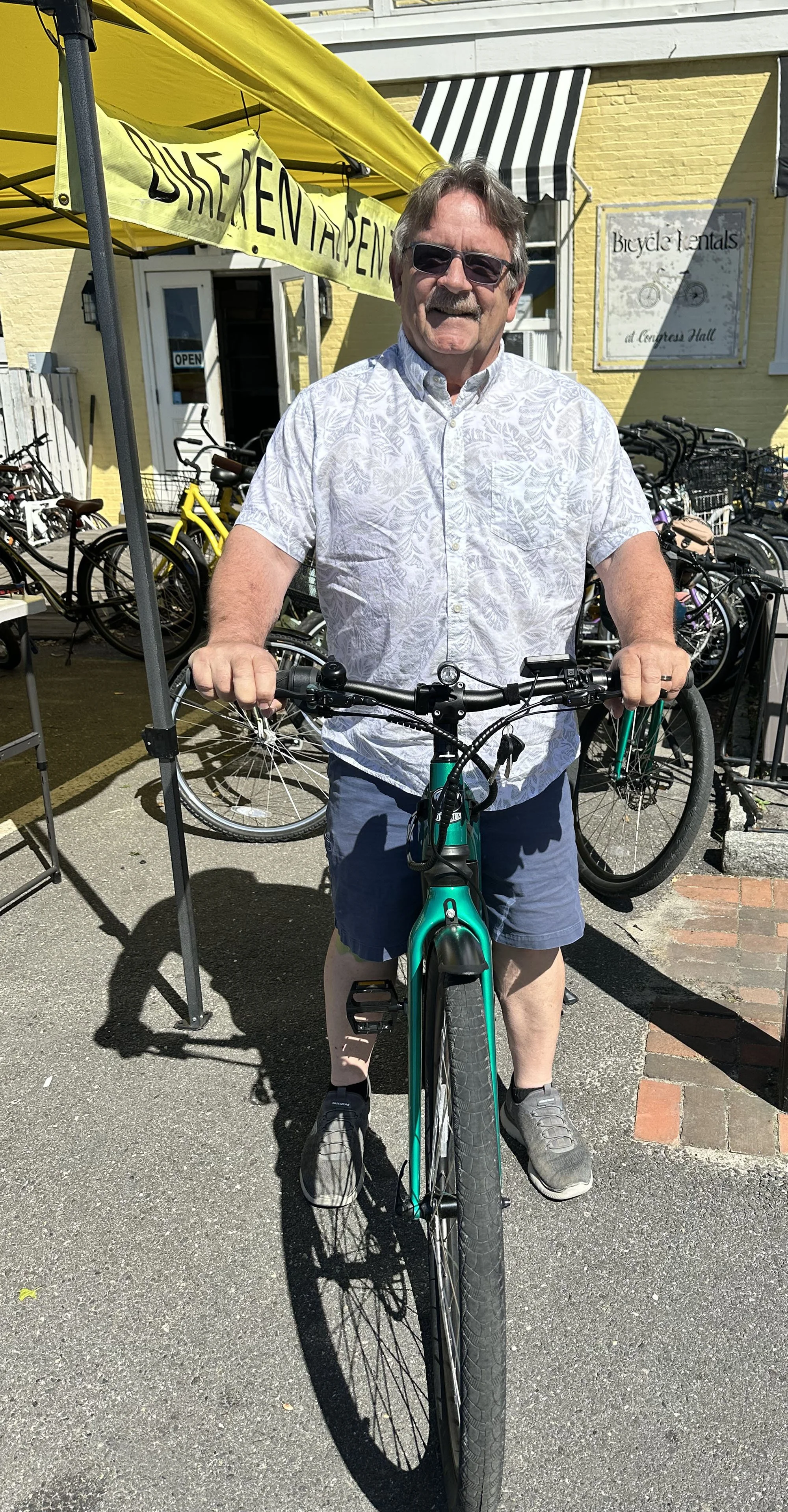
Tom Roth, owner of Cape Island Bikes, has been dealing with e-bikes since 1999