
Rocky Start To Smooth Sailing... A Ferry Tale
There are some ideas that keep bobbing back to the surface no matter how many times history tries to drag them under. The ferry was one of them. You could say it was the town’s most persistent floating fantasy: a practical shortcut, a tourism engine, a civic daydream and, for a while there, a pretty good way to go broke.
Today the Cape May-Lewes Ferry feels as permanent as seagulls, sunburn and somebody in a visor complaining about parking. Part of the landscape. You drive on, you get a Coke or an Orange Crush, you stand at the rail pretending to be thoughtful, you watch the bay do its thing, and an hour-and-a-half later you’re somewhere else. It’s practical, scenic, faintly romantic, and just slow enough to remind you that maybe not every damn thing in life needs to be done at highway speed.
But there was nothing inevitable about it. The ferry we know today opened on July 1, 1964 after decades of false starts, bad timing, political wrangling and at least one famously uncooperative concrete ship. The dream had been around for decades. It didn’t require a genius to see the benefit — South Jersey and lower Delaware were staring at each other across the mouth of the bay like two neighbors who desperately needed a gate in the fence. If you wanted to get from here to there without a ferry, you were in for the sort of drive that made a person question every life choice that had brought them to Route 13.
By the 1920s, it looked as though somebody might finally pull it off. And what a gloriously odd plan it was. Baltimore businessman Jesse Rosenfeld bought the Atlantus, a concrete ship built after World War I, intending to use it not as a ferry itself but as the foundation of a wharf. The idea was to create a dock structure with three old ships arranged in a Y-formation to serve as a bridge between a pier and the boat slips. The Atlantus reached Cape May in June of 1926. Then nature, which has never shown much respect for human plans, intervened. A storm drove the vessel ashore before it could be positioned, and the grand ferry dream went with it. Nearly a century later, the remains of the Atlantus still sit off Sunset Beach as a kind of barnacled monument to ambition, bad luck and the perils of overconfidence near moving water.
Cape May kept waiting. Through the 1930s and 1940s, commissions studied the idea, investors flirted with it, governments considered it and then, as governments do, considered it some more. The town itself was also changing. In the years after World War I, Cape May slipped into one of its periodic funks. The military presence that had boosted the local economy receded, tourists drifted elsewhere, and the old resort was dismissed by many as faded and out of fashion.
The real breakthrough did not come until the early 1960s. Down in Virginia, the old Chesapeake Bay ferry fleet was about to be made obsolete by the new bridge-tunnel. The newly created Delaware River and Bay Authority moved quickly. After taking over the Delaware Memorial Bridge operation and commissioning a feasibility study, the DRBA formally resolved in April 1963 to establish the Cape May-Lewes Ferry. It purchased four vessels from Virginia for about $3.3 million and renamed them Delaware, New Jersey, Cape May and Cape Henlopen. Sometimes history depends on massive political vision. Sometimes it depends on spotting a good secondhand deal.
By the summer of 1964, the terminals were ready and the service was set to begin. The opening was not treated as some dull bureaucratic box-checking exercise. This was a proper event. Governors. Dignitaries. Bands. Ceremonies. Crowds. Flags. Speeches. The whole glorious mid-century civic pageant. America in 1964 still knew how to open something with swagger. We had not yet entered the age of a politician in a windbreaker cutting a ribbon beside three orange cones and a folding table with warm bottled water.
Lewes and Cape May threw themselves into it like two towns delighted to discover they were finally getting a front door instead of a back alley. On June 30, the dedication ceremonies took place. On July 1, the first official public trip left Lewes at 6:47am, seven minutes late, carrying eight vehicles and 15 passengers. The first paying customer drove a black 1964 Ford Mustang aboard, which is exactly the kind of detail that makes history seem scripted by a man in a narrow tie who smoked too much and believed in American chrome.
Because this is the story of a much-jinxed enterprise, the grand opening could not proceed without a touch of mayhem. The Cape May tangled with an underwater cable just before the opening festivities. Officials and guests wound up stuck on the wrong side of the bay while repairs were made. In its first years, the DRBA had to trim schedules, adjust fares and get aggressive about making the operation financially workable. It did. By the 1970s, the authority was commissioning newer purpose-built vessels, and by the 1990s it was modernizing both the fleet and the terminals, transforming the ferry from a useful connector into something closer to a regional institution.
Which brings us to the Beatles, because no proper local history is complete until somebody says, “You know who almost came here once?” I went looking for the story that the Beatles were asked to play for the ferry’s 1964 opening. It is a delicious rumor. It sounds plausible in the way all the best local legends sound plausible: famous band, hot summer, fresh tourist attraction, somebody’s uncle knew somebody in promotions. But after digging through the available sources, I could not verify that the Beatles were formally invited to perform. But the Beatles really were in Cape May later that same summer. On August 31, 1964 they spent a day in Cape May after playing Convention Hall in Atlantic City during their first American tour — playing a 12-song set to 18,000 fans. In Cape May, they stayed at the Marquis de Lafayette. So the Beatles-in-Cape-May story is real; the Beatles-and-the-ferry-opening story is likely not. That is a slightly less exciting answer, I know, but a great many towns survive quite happily on rumors that are 60 percent true and 100 percent fun.
Still, even without John, Paul, George, and Ringo waving from the dock, the ferry had no trouble becoming part of local mythology. That is because it did something more enduring than host a celebrity. It changed the mental map of the region. Suddenly South Jersey was linked directly to Delaware’s beaches and points south. Suddenly Cape May was not the end of the road but part of a route. The ferry made practical life easier for residents, made vacations more interesting for visitors, and added that lovely sense that your journey had begun before you arrived. That is one reason people regard it with affection. The crossing is transportation, yes, but it is also a little bit of theater, too. The gulls circle. The dolphins frolic. Somebody buys fries. Children run around as if the deck were a kingdom. A couple leans on the rail pretending not to enjoy themselves. Then, almost before you know it, another shore appears.
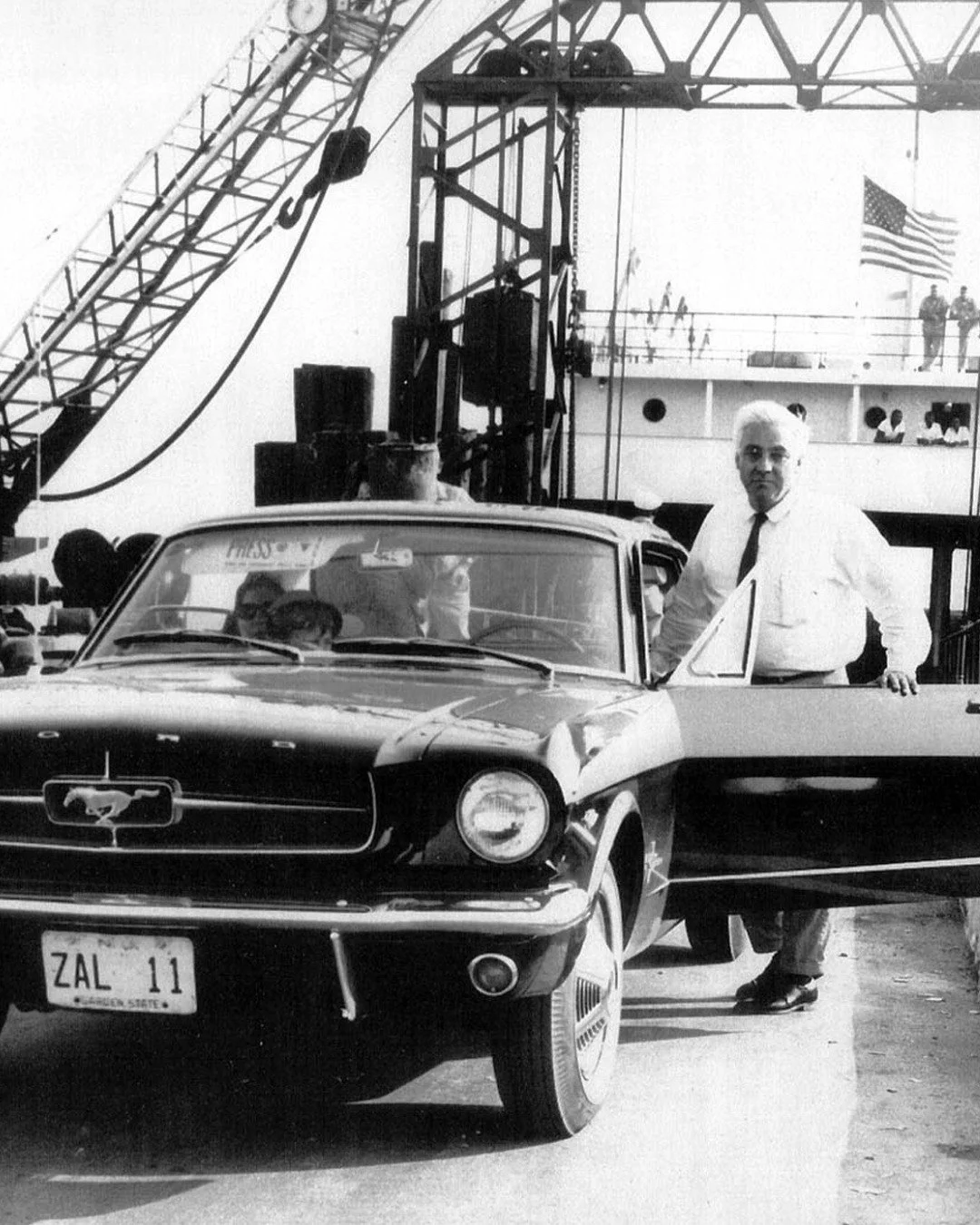
TV performer and poet Andrea Lippi was the first customer to board the ferry in his black Mustang.
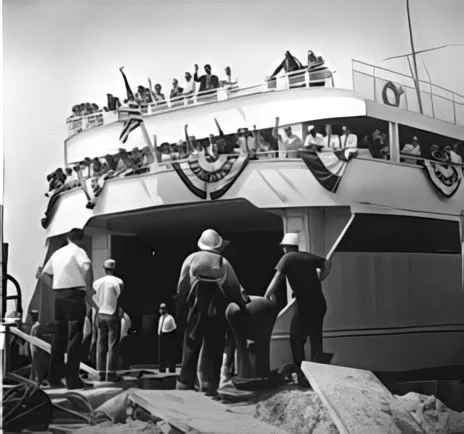
This picture shows the SS Cape May depart for Lewes on a trial run in June of 1964. On opening day, July 1, the same ship ran into a major issue when it tangled with an underwater cable, causing a major delay, and stranding DRBA officials and dignitaries on the other side.
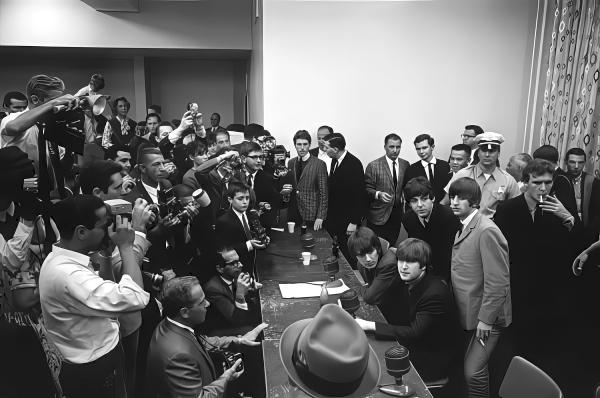
The Beatles at a press conference in Atlantic City ahead of their concert at AC Convention Hall on August 30, 1964. Rumors have persisted that they were originally scheduled to play a concert to celebrate the opening of the ferry, but apparently that wasn’t true. The Fab Four DID, however, spend the night in Cape May after their concert.