Land Of The Giants... When Huge Hotels Ruled Cape May
Every now and again, Cape May gets itself worked into a fine froth over the idea of change. Which is understandable. People come here because Cape May feels like Cape May, which is a rare and delicate thing. You don’t want to wake up one morning and find that America’s Original Seaside Resort has been replaced by Anywhere Beach, USA, with joints like Dick’s Last Resort on the beachfront.
A few years ago, Eustace Mita and ICONA Resorts began floating plans for a grand new hotel at the old Beach Theatre site, across from Convention Hall. Mita presented a concept to city council in October 2021, with a seven-story, 168-room hotel, and by September 2022 ICONA was inviting the public to Convention Hall to review plans for what it called a five-star hotel. Mita’s pitch was that Cape May — “our five-star city,” as he put it — deserved five-star accommodations.
The reaction from many was defiant: absolutely not, delivered in the tone Cape May people reserve for vinyl siding, chain restaurants and architectural renderings that look a little too pleased with themselves.
The proposal was widely criticized as too tall, too big, too much and very un-Cape May. And maybe, in the context of today’s Cape May, the critics had a point. But here is the funny thing about history, which is always standing nearby with a raised eyebrow: hotels of that size were once the norm in pre-Victorian Cape May.
Not the exception. The norm.
In fact, if some of Cape May’s early hoteliers could come back today and walk along Beach Avenue, they might not say, “Good heavens, what have you done?” They might say, “Where did all the big hotels go?”
Before Cape May became famous for its Victorian cottages, it was famous for its hotels. Enormous hotels. Hotels with piazzas running the length of a city block. Hotels that could seat hundreds for dinner at one time. Hotels that rose four, five, even six stories in the salt air, filled with music, invalids seeking sea breezes, families from Philadelphia, Baltimore, Washington, and the promise that life would be much improved after a decent bath in the Atlantic and a better supper than you deserved.
Strictly speaking, the Victorian era began on June 20, 1837, the day Queen Victoria ascended to the British throne. It lasted 63 years, ending with her death in 1901. But Cape May was already well on its way before Victoria ever put on the crown. By 1832, Cape Island — as it was then known — had grown into a proper resort town. Its population had climbed toward 5,000, and visitors had their pick of guest houses and three major hotels: Atlantic Hall, Congress Hall and the Mansion House.
The Mansion House stood between Jackson and Perry. It was considered a marvel because it offered separate rooms for guests and finished interior walls. Imagine that being the luxury selling point: walls!
Richard Smith Ludlam, who built the Mansion House, also helped establish Washington Street as a commercial district. So the next time you are on the mall eating fudge before lunch, remember that the whole idea of that corridor owes something to a hotelier trying to connect his shiny new establishment with the town’s center of gravity.
Then came more hotels. The Ocean House opened in 1832 on Perry, three-and-a-half stories tall, with balconies and views over the lawn of Congress Hall toward the ocean. The Centre House arrived in 1840 on Washington, opposite the Mansion House, and became the largest hotel on the island with room for 400 guests.
In 1842, the McMakin brothers built the New Atlantic. It rose four stories and added 300 beds to their operation. Its dining room took up the entire first floor, with four long tables running nearly the full length of the building. One newspaper account reported 375 plates set at one seating, plus private servants and the hotel’s own staff.
The Columbia House followed in 1846, built by Delaware River captain George Hildreth on what had been swampland between Decatur and Ocean streets. It was four stories tall, elegant, plastered and painted inside and out, with piazzas running along its 180-foot length. Later, it expanded into an L-shape and doubled its room count, becoming the island’s largest boarding house.
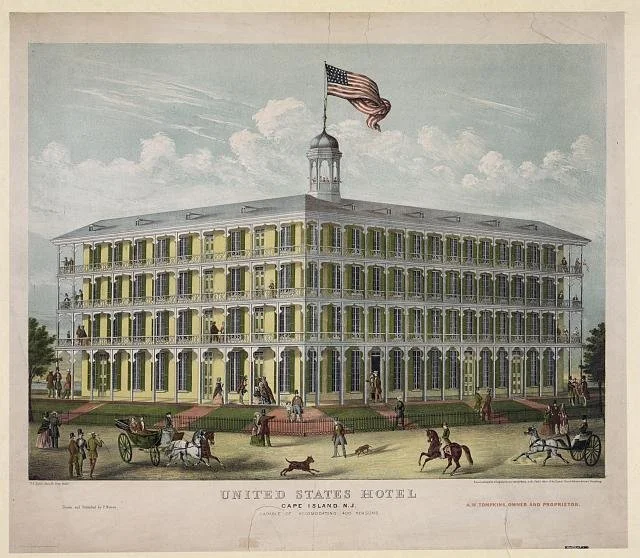
Then came the United States Hotel in 1851, on 10 acres along Washington, stretching from Decatur to Ocean. It had verandas, ocean views and evening entertainment. It was the sort of place where you arrived for a week and emerged in September wondering what you did with your summer other than eat, stroll, bathe, nap and listen to a band.
Which, let’s be honest, remains a perfectly respectable Cape May itinerary.
But the grandest dream of all — the one so big it sounds like Cape May history after three martinis — was the Mount Vernon Hotel. Construction began in 1852. The plan was not merely to build the largest hotel in Cape May. The plan was to build the largest hotel in the world.
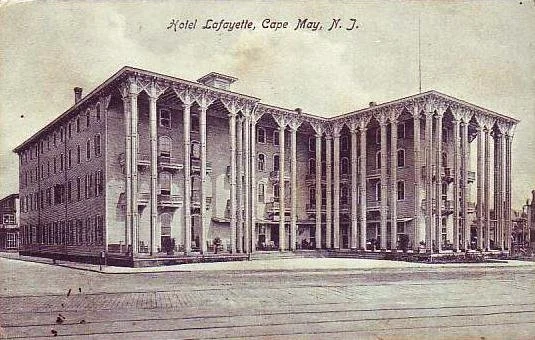
The Lafayette Hotel (now the Marquis), was demolished in 1971.
The Mount Vernon was supposed to accommodate up to 3,500 people. It was promoted as a marvel of modern hospitality, with hot and cold running water, gas lighting in every room, bowling alleys, a pistol-firing range and, according to the London Illustrated News, the first en suite bathrooms on the planet.
Even partially complete, the Mount Vernon could hold more than 2,000 visitors. Contemporary reports described a wooden structure four stories high, with five-story towers at the corners and a six-story tower at the center. Its wing ran about a quarter of a mile. Its dining room was said to be 425 feet long and 60 feet wide, capable of accommodating 3,000 people. There were 432 rooms.
It is difficult for today’s visitor to picture this. Stand near the Cove or wander the western end of town and try to imagine a hotel so vast that it feels less like a building than a district. Try to imagine a place where thousands of guests could dine, promenade, bathe and gossip beneath wooden piazzas stacked from the ground to the roof.
And then imagine it burning.
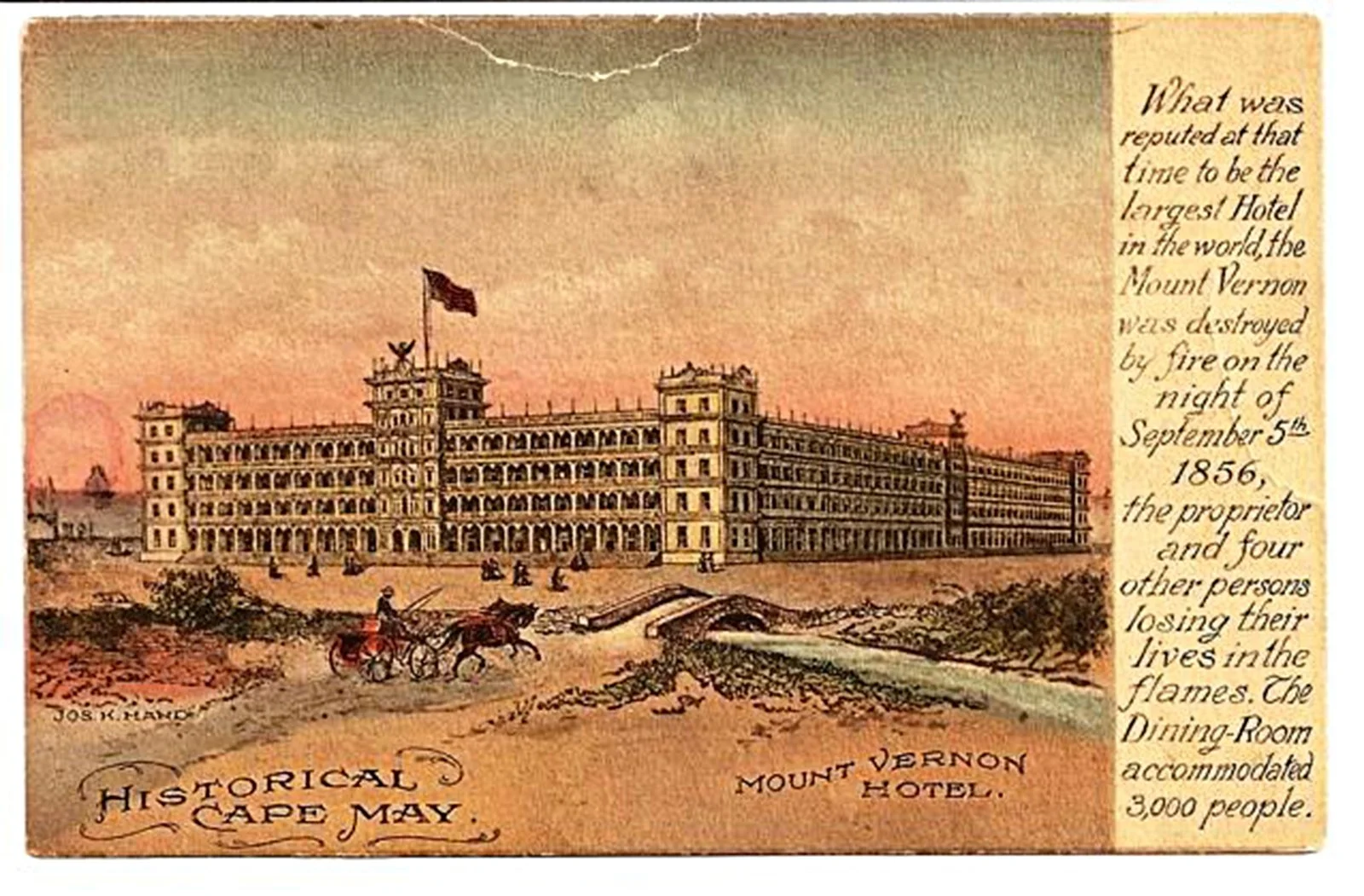
The Mount Vernon Hotel was the biggest in the world before a fire destroyed it in 1856, claiming only the lives of six people because it wasn’t open to guests in September.
On the night of September 5, 1856, with the season over and the hotel empty except for innkeeper Phillip Cain, his children, and housekeeper Anna Albertson, someone entered the building and set it on fire. Cain died. So did his children Anderson, Martha and Sarah. Anna Albertson died too. Phillip Cain Jr managed to escape by leaping from a second-story window, horribly burned, and was taken to the United States Hotel. Before he died the next day, he described the family’s desperate attempts to escapes.
A former housekeeper was arrested, reportedly over a money dispute and suspicion that money had been stolen before the fire was set. But she was released for lack of evidence. No one was ever brought to justice.
Had thousands of guests been inside, Cape May might have remembered the Mount Vernon not as a lost wonder, but as one of America’s great catastrophes.
Then, in 1869, came the Stockton Hotel, built by the West Jersey Railroad. When it opened it was regarded as one of the largest and most fashionable hotels in the country. The Stockton also plays a starring role in the story of the Great Fire of 1878, though mostly by surviving it.
Fire was Cape May’s recurring villain. In 1869, a major blaze damaged the resort and led the city to purchase its first firefighting equipment. But the true reshaping of Cape May came on November 9, 1878, when a fire destroyed 40 acres in the heart of Cape May.
People predicted the resort might never recover. They were wrong. By 1879, rebuilding was underway at remarkable speed. Congress Hall was rebuilt in brick, smaller than before, in just 90 days. New streets were created. Large hotel parcels were subdivided. Cottages rose where vast hostelries had stood. The old resort of colossal wooden hotels gave way to the Cape May visitors know today: intimate, walkable, decorative, Victorian, porch-heavy.
That transformation is the reason newcomers sometimes misunderstand the town. They arrive in Cape May and see painted brackets, towers, shutters, hydrangeas and rocking chairs. They assume this was always the scale of the place. They think Cape May’s soul was born in the smallness.
But Cape May’s first great age was bold, ambitious and occasionally ridiculous. It was a place of hotels the size of ocean liners, dining rooms the length of football fields, steamships carrying thousands, presidents arriving for openings, bands playing through the season, and entrepreneurs betting fortunes on the idea that salt air could cure anything.
And just when Cape May seemed to have learned its lesson about hotel gigantism, the 20th century arrived and said, “Hold my hat.” In 1906, construction began on the Hotel Cape May, the anchor of a vast East Cape May development scheme. The East Cape May Company did not simply want to build a hotel. It wanted to create a ritzy new resort district on the eastern side of the island, expand the harbor, and sell more than 7,000 parcels of land. It was Newport, Rhode Island, with better sunsets and more mosquitoes.
It opened in April 1908, claiming — naturally — to be the largest hotel in the world. It was eight stories tall, with 350 rooms, a brick-and-concrete exterior, and a terracotta tile roof. Guests entered through a grand foyer with a marble floor. It must have been spectacular. It also closed six months after opening because of structural problems.
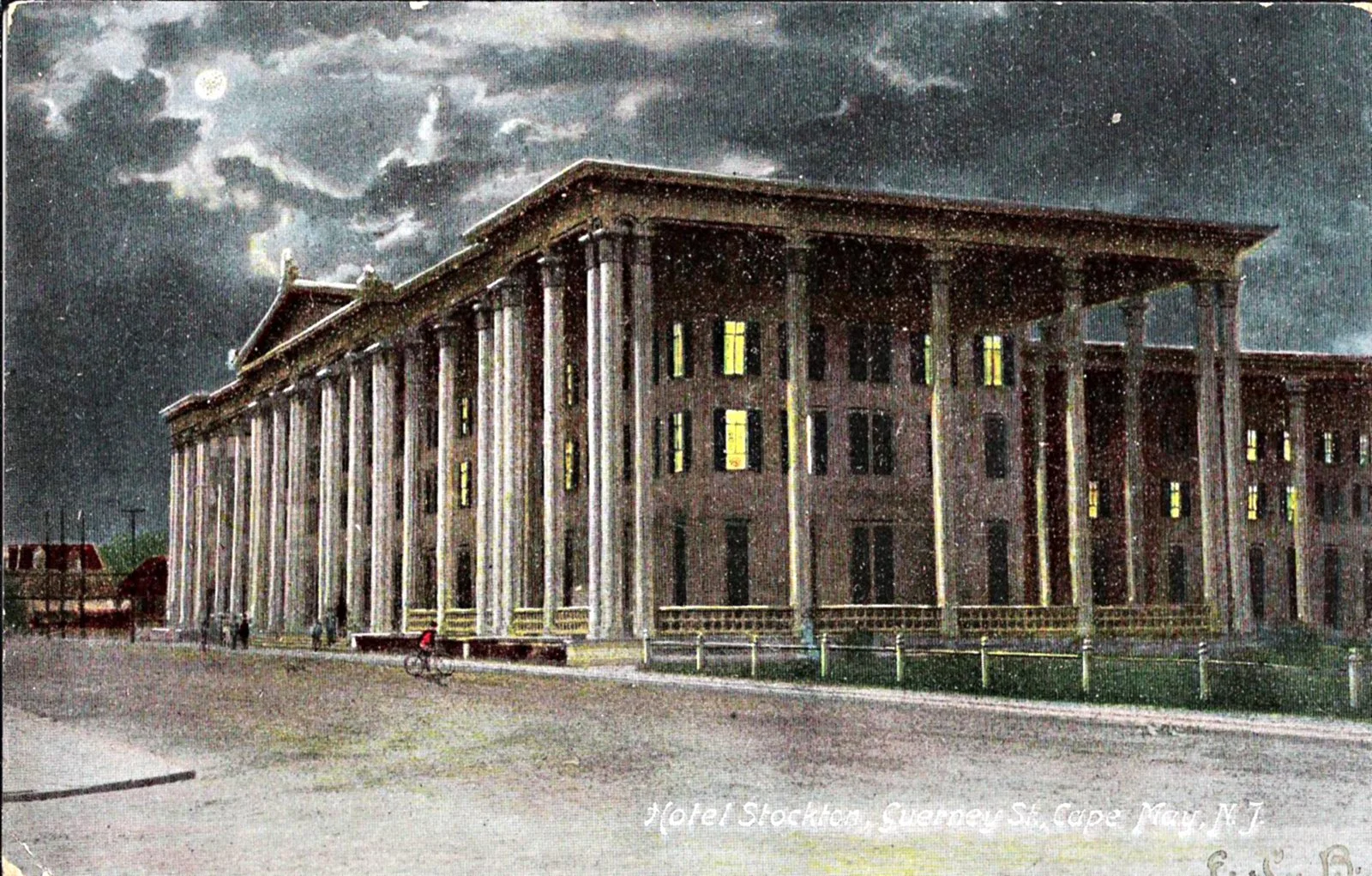
The Stockton Hotel was once considered one of the largest and most fashionable hotels in America.
Then the East Cape May Company collapsed into bankruptcy. Its president, Peter Shields, quit after suffering not only business disaster but the death of his 16-year-old son Earl in a hunting accident while the hotel was still being built. His successor, Frederick Feldner, met his own terrible end in 1910, when he, his wife, his daughter, his son-in-law and chauffeur were killed after their automobile was struck by the Philadelphia-Cape May express train at a crossing. A third company president, Nelson Z. Graves, later declared bankruptcy at 34.
At this point, even the least superstitious visitor might have glanced at the hotel and said, “No, thank you, I’ll stay somewhere with fewer omens.”
So when you walk past Congress Hall, or along Perry, Jackson, Decatur, Ocean, Washington or Beach, you are not just strolling through a preserved Victorian resort. You are walking over the footprints of vanished giants. The Mansion House is gone. The Centre House is gone. The Ocean House is gone. The Columbia House is gone. The United States Hotel is gone. The Stockton, once one of the proudest and largest hotels in the country, is gone. The Mount Vernon, the biggest dream of them all, disappeared in one awful night before it ever reached its full glory. The Hotel Cape May — later the Admiral, then the Christian Admiral — survived almost 90 turbulent years before it went down in 1996.
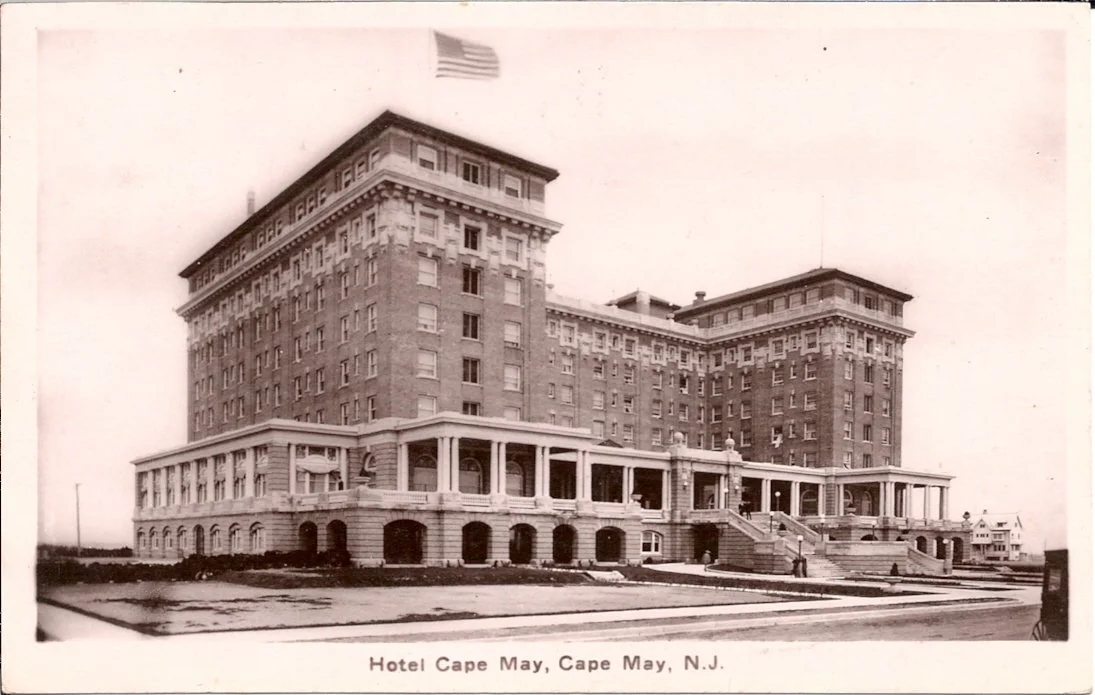
The Hotel Cape May (which later became the Admiral and then Christian Admiral) dominated the Cape May skyline until its demolition in 1996.
That is the real story for today’s visitor. The town did not become America’s Original Seaside Resort because it never changed. It became Cape May because it changed, burned, rebuilt, adapted, argued, mourned, and then opened for another season.
Just a thought or two to ponder while you contemplate your ice cream or packet of fudge.