
Thar She Blows... And There Goes Cape May’s 4:15 Dolphin!
There are tourists who ask Cape May lifeguards what time the dolphins will be passing by the beach. You can understand the confusion. The Cape May-Lewes Ferry has a timetable. The horse-drawn carriages have a timetable. Even the sunsets, broadly speaking, keep their appointments. So why wouldn’t the dolphins be due off Queen Street at 4:15pm, preferably leaping in formation while everyone has their phones ready?
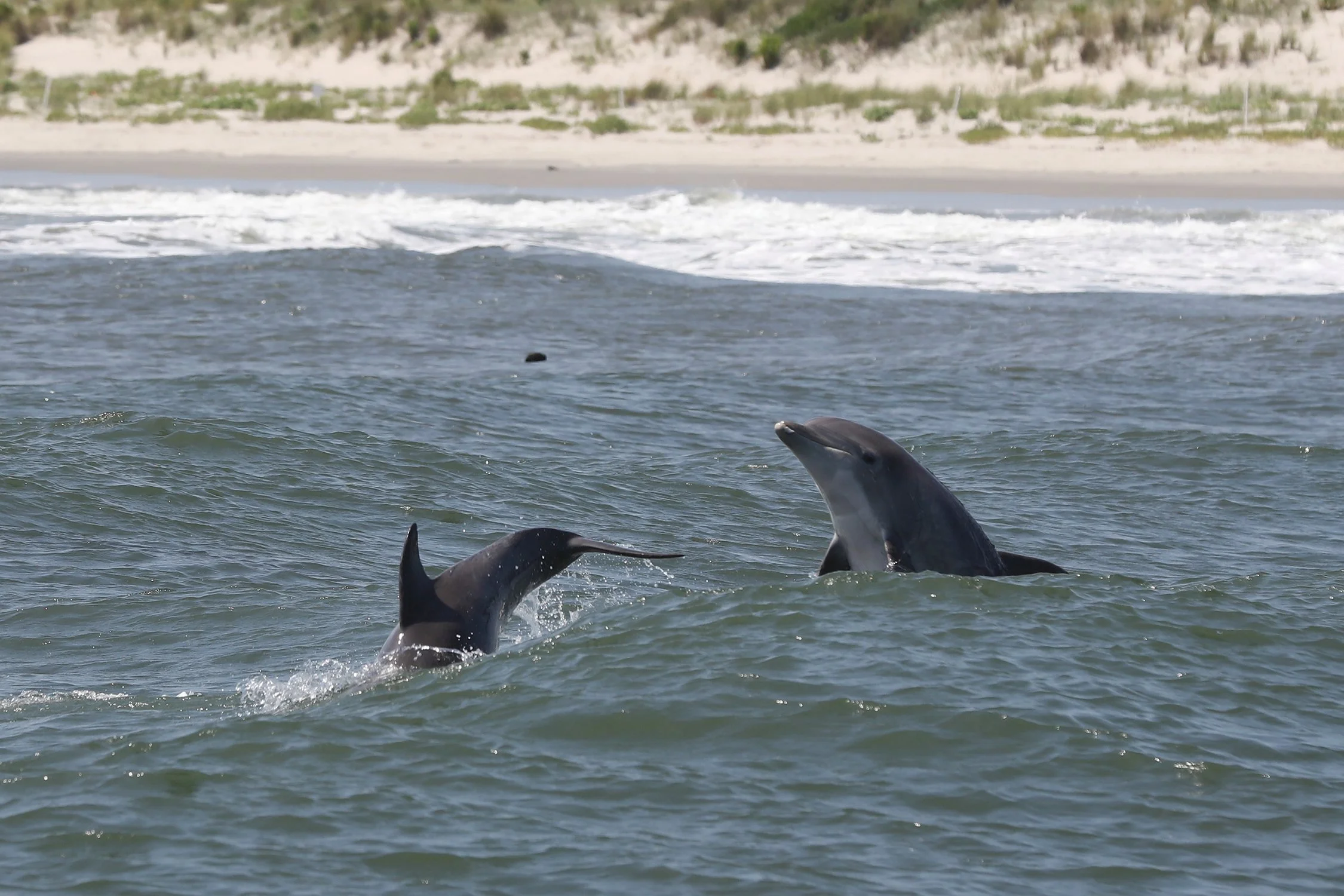
The truth is that dolphins appear when they feel like it, sometimes so close to shore that swimmers can hear them breathing. They might cruise past in an orderly line, explode through a school of fish or simply vanish beneath the surface.
But here is the curious thing. Four centuries ago, people stood on this same coastline watching for the dolphins’ big cousins, whales, with a different purpose. They weren’t hoping for a photograph. They were hoping to kill one.
Cape May’s European story began not with Victorian hotels, presidents or tourists complaining about parking, but with whales. Town Bank, the quiet bayside community between North Cape May and the Villas, was Cape May before Cape May was Cape May.
The exact date of its settlement is maddeningly slippery, but New England and Long Island whalers were establishing themselves along the Delaware Bay during the 1600s. The high sandy bluff at Town Bank, around 20 feet above the water, made an excellent lookout.
In March 1633, Dutch trader David Pietersz de Vries recorded that his men had caught seven whales. They had actually struck 17 but lost 10 because, he complained, they lacked good harpoons — which suggests a bay so full of whales that losing 10 of them was less a financial tragedy than an equipment complaint.
The Kechemeche people, part of the Lenape that lived around the lower peninsula, already knew and used these waters. There is good evidence that indigenous people claimed and harvested whales that stranded on the beaches. A 1685 court record concerns a Native man selling a whale to settlers.
Some local accounts say the Kechemeche taught the newcomers how to hunt whales. That may be true, but the surviving record is not strong enough to confidently describe an indigenous whaling fleet setting out in boats. What we can say is that they understood the animals, made use of beached whales and sometimes competed with colonists for possession of them. The Europeans then turned that knowledge and abundance into an organized commercial industry.
The favored animal was almost certainly the North Atlantic right whale. It hugged the coast, moved relatively slowly and, crucially, floated after it was killed. That made it the “right” whale to hunt from a small open boat.
Fin whales were known here, too. Eighteenth-century whaler Lewis Cresse recorded seeing spouts that he believed were “chiefly fin backs.” But fast, powerful fin whales were a much more difficult proposition for men armed with oars, rope and hand-thrown iron. Sperm whales were enormously valuable elsewhere, but the Town Bank trade was primarily shore whaling, not the globe-circling industry associated with Nantucket and New Bedford.
When a lookout spotted a whale, six men ran for a locally built boat — a harpooner, a boat-steerer and four oarsmen. They rowed toward an animal that might weigh 50 tons, got close enough for one man to throw a harpoon and then discovered what sort of mood the whale was in. Usually a bad one.
A harpooned whale could dive, roll, smash the boat with its tail or tow the crew at terrifying speed. The men faced freezing water, winter seas, tangled lines, broken boats and the possibility of being drowned or crushed by the largest animal they had ever seen.
Cresse, a Cape May farmer who went whaling for about a month early in most years, left us a detailed account from 1764. A whale turned repeatedly beneath his boat and when harpooner Jacob Hand threw his iron, the creature struck the boat with such violence that, according to Cresse, it looked like a whirlwind lifting oak leaves. He estimated the boat had been broken into 500 pieces.
Miraculously, everyone survived.
You might imagine that the men went home, stood in front of the fire and reconsidered their career choices. Instead, some of the company remained “very lively to try another chance.” They borrowed Captain Stillwell’s boat from Egg Harbor, went out again, killed another whale and harvested 23 barrels of oil.
This is one reason these early whalers became prosperous landowners. In 1695, Thomas Hand owned 400 acres and Caesar Hoskins owned 150. These men were not romantic wanderers of the sea. They were farmer-whalers, combining land, livestock and seasonal maritime gambling in an economy where one successful whale could transform a year.
Once dragged ashore, the animal became an industrial site. Blubber was cut away and rendered into oil for lamps and lubrication. Oil also found its way into soap and other manufactured products. Baleen — the flexible filtering plates in the mouths of right whales — became corset stays, skirt hoops, umbrella ribs, buggy whips, hat brims, carriage springs and collar supports. Bone and tissue could be ground for fertilizer.
In the 1700s, the whale was less an animal than an enormous floating hardware store.
For a while, business boomed. William Penn reported 11 whales caught in one season. In 1718, the Boston News-Letter reported six whales killed off Cape May and 12 off Egg Harbor. Then came the inevitable collapse: the coastal whales had been hunted away. The final known local whaling transaction came in 1775, when part of Seven Mile Beach was leased to whalers for 30 days.
And what about dolphins? Why did nobody hunt those charming creatures?
Well… they did.
In the 1880s, a short-lived Porpoise Fishing Company was organized at Cape May. At the time, people routinely called dolphins “porpoises,” and the company targeted bottlenose dolphins, sometimes taking 70 or more during one voyage. Oil from the jaw and head made for a fine lubricant, while hides could be made into leather.
So dolphins were not spared because Cape May’s ancestors found them too intelligent, adorable or good at performing synchronized jumps. They were simply a smaller and less lucrative target than a giant baleen whale.
The modern relationship with these animals began to reverse during the second half of the 20th century. Cape May sightseeing trips existed by the 1950s. Captain Jeff Stewart says he was taking part in sightseeing, dolphin and whale trips as early as 1973 and launched the Cape May Whale Watcher in 1993 with his wife Mary — the family still runs it today.
But the starting point for Cape May’s dedicated whale-watching industry is 1987, when Ron Robbins founded the Cape May Whale Watch and Research Center. Robbins began taking passengers out specifically to see marine mammals. In 2007, Jim Cicchitti and his wife Tracie bought the center and continued its research and education work. In 2023, the torch was passed to Matt and Melissa Remuzzi, who were previously longtime members of the Cicchitti crew.
Which brings us back to those people on the beach pointing at the water.
Yes, there really are whales off Cape May. Humpbacks are today’s most frequently sighted stars, drawn by schools of oily Atlantic menhaden or bunker. Fin whales and minkes also appear, with the occasional critically endangered North Atlantic right whale passing through. In spring 2024, all four species were reported within 10 miles of Cape May. Humpbacks have been seen inside Delaware Bay and, when the food comes inshore, within around 100 yards of the beach.
A local research catalog documented more than 230 individual humpbacks between 2011 and 2023. Researchers identify them from the patterns beneath their tail flukes, which work rather like fingerprints.
The everyday celebrities, though, are the dolphins. A Cape May study conducted in 2013 and 2014 estimated a local population of about 1,039 bottlenose dolphins. That is not a current census — nobody is issuing dolphin beach tags — but it gives a sense of the abundance.
The sleek gray animals commonly seen beside the beaches are the coastal bottlenose species. Farther offshore, common dolphins display a tan-and-gray hourglass pattern. Atlantic spotted dolphins acquire spots as they age, while Risso’s dolphins have blunt heads and bodies so heavily scratched by other dolphins and squid that older animals can appear almost white.
A porpoise is not simply a dolphin having a bad day. Both are toothed whales, but dolphins generally have longer beaks, curved dorsal fins and cone-shaped teeth. Porpoises are smaller and stouter, with blunt faces, triangular fins and spade-shaped teeth. Harbor porpoises do visit New Jersey waters, especially in cooler months, but they are shy, travel in small groups and rarely charge over to entertain a boatload of tourists.
So the next time somebody asks a lifeguard when the dolphins are coming, the correct answer is: when the bunker arrive, when the tide and water suit them and when several hundred pounds of highly intelligent marine mammal decide to make an entrance.
Which is not especially helpful if you are trying to plan lunch.
But it is surely better than the old timetable. Four hundred years ago, a spout meant men running for harpoons. Today it produces delight, binoculars, research photographs and 300 people shouting, “Over there!”
For once, history has moved in the right direction.
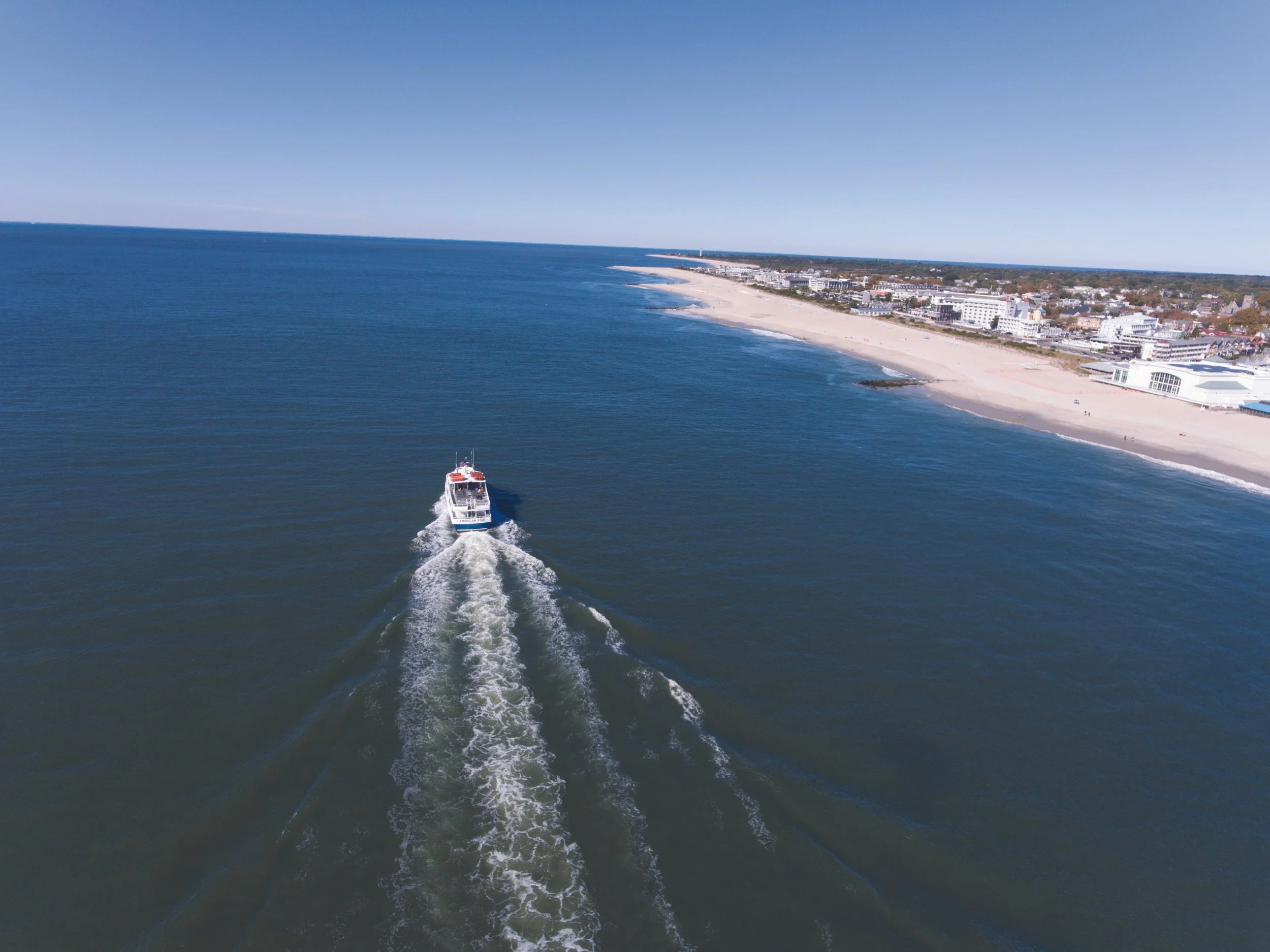
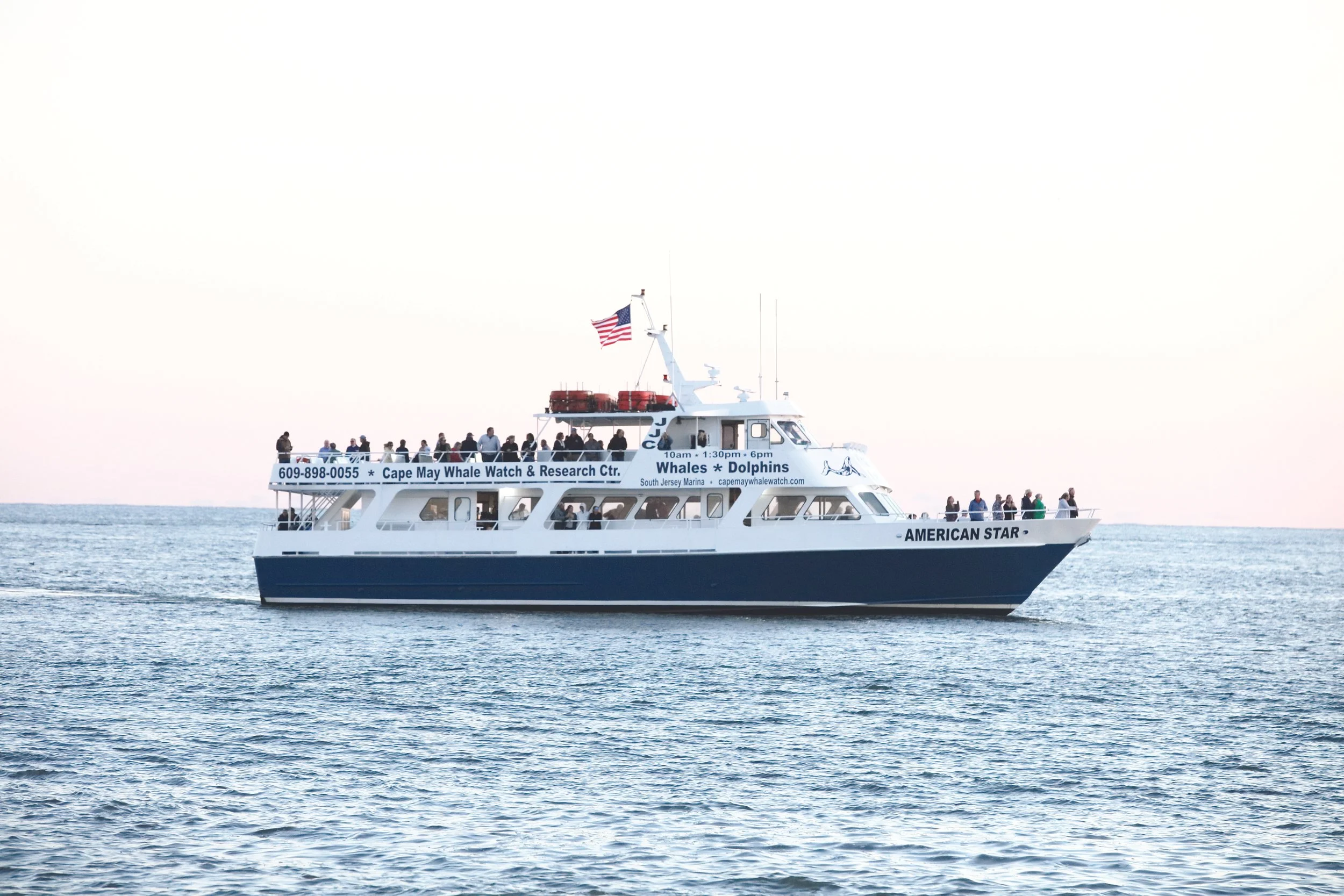
The American Star, operated by Cape May Whale Watch and Research Center, offers whale and dolphin-watching cruises, along with a slate of longer, more adventurous, nature-focused cruises.